Question
Discuss any two points due to which Mendel got success in his experiment?

Answer

Following are the reasons for Mendel’s success:
  1. His experiments were carefully planned and involved a large sample.
  2. He carefully recorded the number of plants of each type and expressed his results as ratios.
  3. In the pea plant, contrasting characters can be easily recognized.
  4. The seven different characters in the pea plant were controlled by a single factor each.
  5. The factors are located on separate chromosomes and these factors are transmitted from generation to generation.

Need a full question paper?

Generate a complete, print-ready paper with questions like this in minutes — across 16+ boards, with answer keys.
Start Generating Free

Similar questions

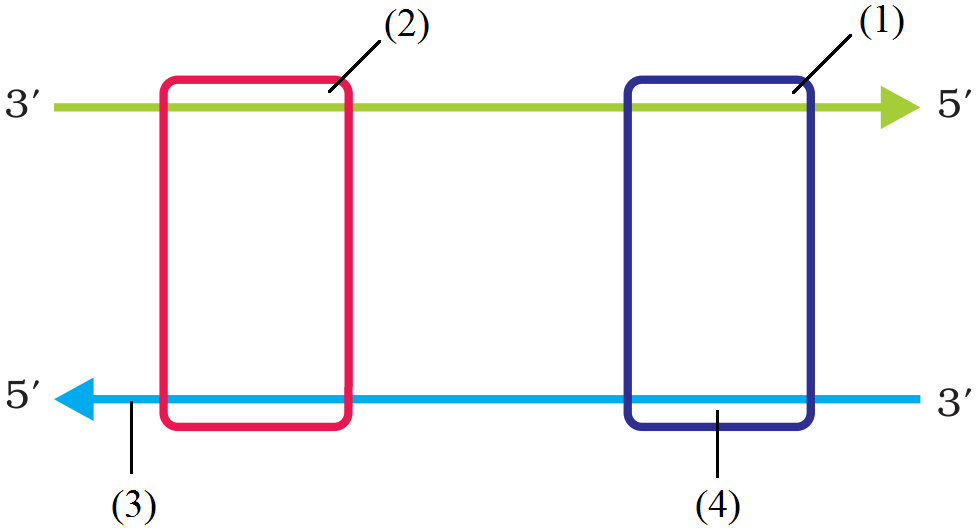
In the following diagram the two DNA strands represented are ready for transcription.
  1. Label the parts marked 1 to 4 and state their functions in transcription.
  2. Which one of the two strands of DNA has nucleotide sequence similar to the mRNA that will be transcribed and why?
What is a terminator? What is its significance in transcription?
Write the names of two dinosaurs that lived early in the history of earth and two others that lived little later.
Sketch and label T.S. of Artery.
Categorise the following pairs of examples as convergent or divergent evolutions:
  1. Eyes of Octopus and mammals.
  2. Wings of butterfly and birds.
  3. Tuber of sweet potatoes and potato.
  4. Thorns in Bougainvillea and tendrils in Cucurbits.
In a dihybrid cross white eyed, yellow bodied female Drosophila crossed with red eyed, brown bodied male Drosophila produced in $F_2$​​​​​​​ generation, $1.3$ per cent recombinants and $98.7$ per cent progeny with parental type combinations. This observation of Morgan deviated from Mendelian $F_2$​​​​​​​ phenotypic dihybrid ratio. Explain, giving reasons, Morgan’s observations.
Write any four ways used to introduce a desired DNA segment into a bacterial cell in recombinant technology experiments.
Give the location and one function of the following receptors
(i) Mechanoreceptors (ii) Statoacoustic receptors (iii) Baroreceptors
Group the following as nitrogenous bases and nucleosides:
Adenine, Cytidine, Thymine, Guanosine, Uracil and Cytosine.
  1. Expand CFC.
  2. How does it reduce ozone to oxygen?