Question
Discuss briefly about seed viability.

Answer

Seed viability : Different seeds have diverse seed variability. The germination capacity of
mature seeds ends within a month, many have the viability for years and some for many years. The germenation capacity of mature seeds remains even after a long time has passed and this is known as seed viability. The seeds of leupire (lupinus arctinus) excavated from Arctic. Tundra were about 100000 years old. A recent record of 2000 years old viable seed is of date palm (phoenix dactylifera discovered during the excavation at king Herod’s palace near the dead sea, when sown, germinate flower. Therefore each seed has different viability.
Need a full question paper?

Generate a complete, print-ready paper with questions like this in minutes — across 16+ boards, with answer keys.

Start Generating Free

Similar questions

Write a short note on female accessory ducts.
How are eurythermal animals different from stenothermal animals? Give an example of each.
In relation to energy transfer in ecosystem, explain the statement "10kg of deer's meat is equivalent to 1kg of lion's flesh".
In a sea shore, the benthic animals live in sandy, muddy and rocky substrata and accordingly developed the following adaptations.
  1. Burrowing.
  2. Building cubes.
  3. Holdfasts/ peduncle.
Find the suitable substratum against each adaptation.
Eco RI is used to cut a segment of foreign DNA and that of a vector DNA to form a recombinant DNA. Show with the help of schematic diagrams.
  1. The set of palindronic nucleotide sequence of base pairs the Eco RI will recognise in both the DNA segments. Mark the site at which Eco RI will act and cut both the segments.
  2. Sticky ends formed on both the segments where the two DNA segments will join later to form a recombinant DNA.
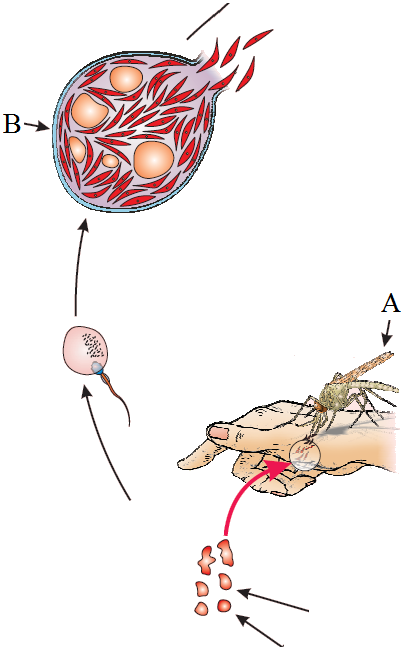
Study a part of the life cycle of malarial parasite given below. Answer the questions that follow:

  1. Mention the roles of 'A' in the life cycle of the malarial parasite.
  2. Name the event 'C' and the organ where this event occurs.
  3. Identify the organ 'B' and name the cells being released from it.
Differentiate between geitonogamy and xenogamy in plants. Which one between the two will lead to inbreeding depression and why?
From which germ layers do the following organs differentiate?
  1. Kidney.
  2. Urinary bladder.
Explain the role of baculoviruses as biological control agents. Mention their importance in organic farming.

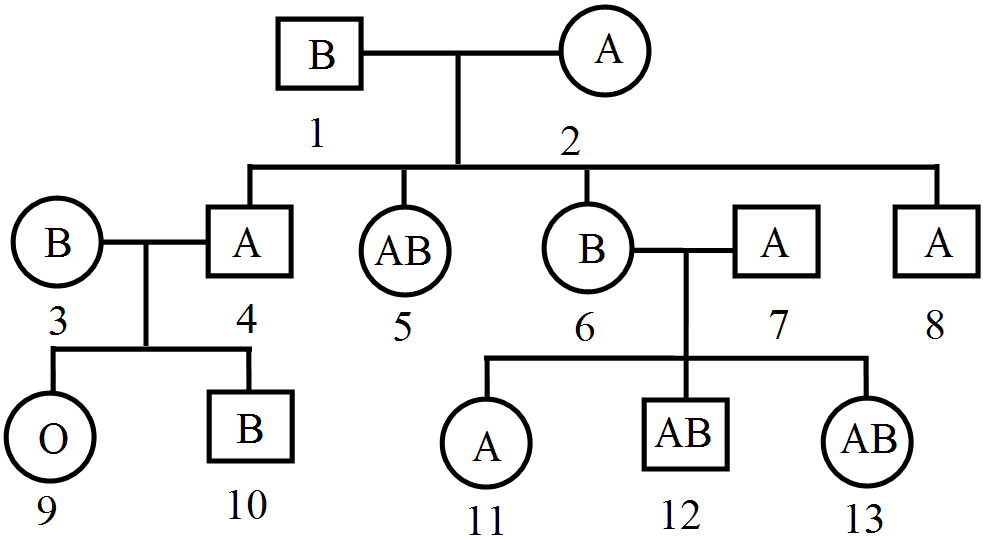
Study the pedigree chart given above, showing the inheritance pattern of blood groups in a family and answer the following questions:
  1. Give the possible genotypes of the individuals 1 and 2.
  2. Which antigen or antigens will be present on the plasma membranes of the RBCs of individuals 5 and 9?
  3. Give the genotypes of the individuals 3 and 4.