Question
Discuss induced emf produced in a conducting rod during its motion in direction perpendicular to uniform magnetic field with reference to Lorentz force and obtain its expression.

Answer

Force acting on free electron is $\overrightarrow{ F }=-e(\vec{v} \times \overrightarrow{ B })$. Due to this force, free electron tend to meet at end Q and same amount of positive charge gets exposed at end $P$. Potential difference arising between P and Q has value $B vl$. Thus, it acts like a battery having emf $\varepsilon= Bvl$.

Need a full question paper?

Generate a complete, print-ready paper with questions like this in minutes — across 16+ boards, with answer keys.
Start Generating Free

Similar questions

What will be the change in specific resistance of copper wire when (i) length is made three times (ii) area of cross-section is made three times (iii) radius is made three times and (iv) temperature is increased?
Obtain Faraday's law of induction explaining Faraday's experiments regarding electric induction with reference to magnetic flux.
Two metallic wires A and B made from same substance have equal lengths and their cross-sections are in the ratio $1: 2$. They are joined in (i) series (ii) parallel. In both the above combinations, compare the drift velocities of electrons in the two wires.
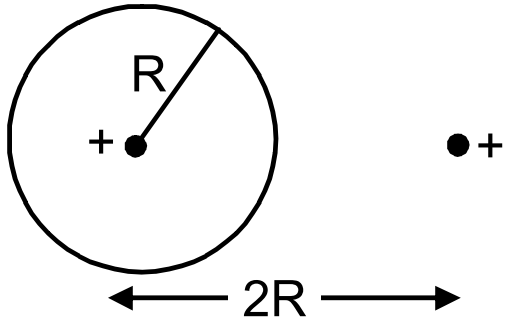
Find the flux of the electric field through a spherical surface of radius R due to a charge of 10-7C at the centre and another equal charge at a point 2R away from the centre.

Discuss the similarities and differences of BiotSavart law with the Coulomb's law.
Explain emission lines and absorption lines.
A 100pF capacitor is charged to a potential difference of 24V. It is connected to an uncharged capacitor of capacitance 20pF. What will be the new potential difference across the 100pF capacitor?
What is paramagnetic substance?
A man moves on a straight horizontal road with a block of mass 2kg in his hand. If he covers a distance of 40m with an acceleration of 0.5m/s2, find the work done by the man on the block during the motion.
The minimum deviations suffered by red, yellow and violet beams passing through an equilateral transparent prism are 38.4°, 38.7° and 39.2° respectively. Calculate the dispersive power of the medium.