Question
Discuss structure of the carbonyl group.

Answer

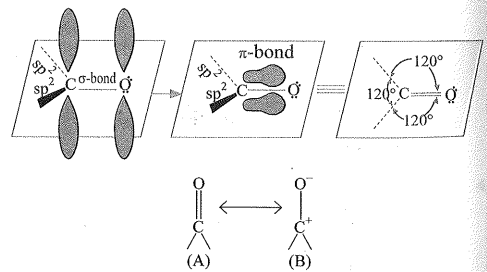
$\rightarrow$ The carbonyl carbon atom is $sp^2-$hybridised and forms three sigma $(\sigma )$ bonds.
$\rightarrow$ The fourth valence electron of carbon remains in its $p-$orbital and forms a$ \pi -$bond with oxygen by overlap with $p-$orbital of an oxygen.
$\rightarrow$ In addition, the oxygen atom also has two non bonding electron pairs. Thus, the carbonyl carbon and the three atoms attached to it lie in the same plane and the $\pi -$electron cloud is above and below this plane.
$\rightarrow$ The bond angles are approximately $120^\circ$ as expected of a trigonal coplanar structure $($Fig$.).$​​​​​​​
Image
$\rightarrow$ The carbon$-$oxygen double bond is polarised due to higher electronegativity of oxygen relative to carbon. Hence, the carbonyl carbon is an electrophilic $($Lewis acid$),$ and carbonyl oxygen, a nucleophilic $($Lewis base$)$ centre. Carbonyl compounds have significant dipole moments and are polar than ethers. The high polarity of the carbonyl group is explained on the basis of resonance involving neutral $(A)$ and a dipolar $(B)$ structures as shown.

Need a full question paper?

Generate a complete, print-ready paper with questions like this in minutes — across 16+ boards, with answer keys.
Start Generating Free

Similar questions

Name two complexes which are used in medicines.
How much electricity will be required to obtain 1.5 gram on copper in 3 hours in an electrolytic cell of aqueous solution of copper sulphate? (Atomic mass of Cu = 63.5 )
How would you account for the following:
  1. Among lanthanoids, $\ce{Ln} \ (III)$ compounds are predominant. However, occasionally in solutions or in solid compounds,$\ +2 $ and $ \ +4$ ions are also obtained.
  2. The $\ce{E^o_{M^{2+}/M}}$ for copper is positive $(0.34V)$. Copper is the only metal in the first series of transition elements showing this behaviour.
  3. The metallic radii of the third $(5d)$ series of transition metals are nearly the same as those of the corresponding members of the second series.
A $4\%$ solution$(w/ w)$ of sucrose $(M = 342g\ mol^{-1})$ in water has a freezing point of $271.15K.$ Calculate the freezing point of $5\%$ glucose $(M = 180g\ mol^{-1})$ in water.
$($Given: Freezing point of pure water $= 273.15K)$
On the basis of the following data, explain why $Co - \ (III)$ is not stable in aqueous solution? 
$\ce{Co^{3+}+e^{-} \rightarrow Co^2+, E^0=+1.82 V}$
$\ce{2 H_2 O \rightarrow O_2+4 H^{+}+4 e^{-}, E^0=1.23 V}$
Colour of $\ce{KMnO_4}$ disappears when oxalic acid is added to its solution in acidic medium.
On what basis can you say that scandium $(Z = 21)$ is a transition element but zinc $(Z = 30)$ is not?
Write down the $\text{IUPAC}$ name for the following complex and indicate the oxidation state, electronic configuration and coordination number. Also give stereochemistry and magnetic moment of the complex:
$\ce{[Co(NH_3)_5Cl-]Cl_2}$
Write the Nernst equation and emf of the following cells at $298\ K:$
$Mg(s) | Mg^{2+}(0.001M) || Cu^{2+}(0.0001 M) | Cu(s)$
Boiling point of water at $750\ mm$ Hg is $99.63^\circ C.$ How much sucrose is to be added to $500\ g$ of water such that it boils at $100^\circ C.$