Question
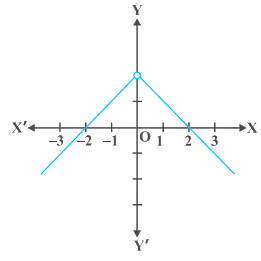
Discuss the continuity of the function defined by $f(x)=\left\{\begin{array}{c} {x+2, \text { if } x<0} \\ {-x+2, \text { if } x>0} \end{array}\right.$
Answer

Observe that the function is defined at all real numbers except at $0$ .
The domain of definition of this function is $D_1 \cup D_2$
where $D_1 = \{x \in R : x < 0\}$ and $D_2 = \{x \in R : x > 0\}$
Case $1$: If $c \in D_1$, then $\mathop {\lim }\limits_{x \to c} f(x) = \mathop {\lim }\limits_{x \to c}  \ (x + 2)
= c + 2 = f (c)$ and hence $f$ is continuous in $D_1.$
Case $2$ : If $c \in D_2,$ then $\mathop {\lim }\limits_{x \to c} f(x) = \mathop {\lim }\limits_{x \to c} \,\,$(-x + 2)
= – c + 2 = f (c)$

and hence f is continuous in $D_2.$
Since f is continuous at all points in the domain of $f,$ we deduce that f is continuous.
The graph of this function is given in the figure.
Note that to graph this function we need to lift the pen from the plane of the paper, but we need to do that only for those points where the function is not defined.

Need a full question paper?

Generate a complete, print-ready paper with questions like this in minutes — across 16+ boards, with answer keys.

Start Generating Free