Question
Discuss the continuity of the function f defined by $f(x)=\left\{\begin{array}{l} {x+2, \text { if } x \leq 1} \\ {x-2, \text { if } x>1} \end{array}\right.$
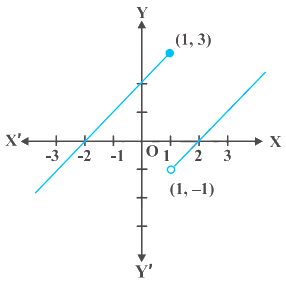
Answer

The function f is defined at all points of the real line.

Case 1: If c < 1, then f(c) = c + 2.
Now, $\mathop {\lim }\limits_{x \to c} f(x) = \mathop {\lim }\limits_{x \to c} $(x + 2) = c + 2
Thus, f is continuous at all real numbers less than 1.
Case 2: If c > 1, then f(c) = c - 2.
Now, $\mathop {\lim }\limits_{x \to c} f(x) = \mathop {\lim }\limits_{x \to c} $ (x - 2) = c - 2 = f (c)
Thus, f is continuous at all points x > 1.
Case 3: If c = 1, then the left-hand limit of f at x = 1 is
$\mathop {\lim }\limits_{x \to 1^-} f(x) = \mathop {\lim }\limits_{x \to 1^-} $(x + 2) = 1 + 2 = 3
The right hand limit of f at x = 1 is
$\mathop {\lim }\limits_{x \to 1^+} f(x) = \mathop {\lim }\limits_{x \to c^+} $(x - 2) = 1 - 2 = -1
Since the left and right hand limits of f at x = 1 do not coincide, f is not continuous at x = 1.
Hence x = 1 is the only point of discontinuity of f.

Need a full question paper?

Generate a complete, print-ready paper with questions like this in minutes — across 16+ boards, with answer keys.

Start Generating Free