Question
Discuss the continuity of the function f given by
$f(x)=\left\{\begin{array}{ll} {x,} & {\text { if } x \geq 0} \\ {x^{2},} & {\text { if } x<0} \end{array}\right.$
Answer

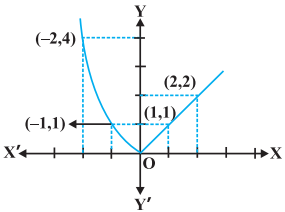
Clearly, the function is defined at every real number. The graph of the function is given in figure. By inspection, it seems prudent to partition the domain of definition of f into three disjoint subsets of the real line.

Let D1 = {x $\in$ R : x < 0}, D2 = {0} and D3 = {x $\in$ R : x > 0}
Case 1: At any point in D1 , we have f(x) = x2 and it is easy to see that it is continuous there
Case 2: At any point in D3 , we have f(x) = x and it is easy to see that it is continuous there
Case 3: Now we analyse the function at x = 0. The value of the function at 0 is f(0) = 0. The left hand limit of f at 0 is
$\mathop {\lim }\limits_{x \to {0^ - }} f(x) = \mathop {\lim }\limits_{x \to {0^ - }} {x^2} = {0^2} = 0$
The right-hand limit of f at 0 is
$\mathop {\lim }\limits_{x \to {0^ + }} f(x) = \mathop {\lim }\limits_{x \to {0^ + }} x = 0$
Thus $\mathop {\lim }\limits_{x \to {0^ + }} f(x)$ = 0 = f(0) and hence f is continuous at 0. This means that f is continuous at every point in its domain and hence, f is a continuous function.

Need a full question paper?

Generate a complete, print-ready paper with questions like this in minutes — across 16+ boards, with answer keys.

Start Generating Free