DUAL NATURE OF RADIATION AND MATTER — Physics STD 12 Science — Question
Gujarat BoardEnglish MediumSTD 12 SciencePhysicsDUAL NATURE OF RADIATION AND MATTER4 Marks
Question
Discuss the Einstien's explanation for the photoelectric effect.
✓
Answer
$\rightarrow $ In 1905, Einstien gave a historical explanation of the photoelectric effect. For which he was awarded the Nobel prize in physics in 1921.
$\rightarrow $ Einstein accepted Max Planck's concept of radiation.
$\rightarrow $ According to this concept, the energy of radiation is not continuous. Radiation is composed of discrete units of energy, $($Bundles of energy$)$ These units of energy are called quanta or photons.
Each quantum $($photon$)$ has energy $E =h v$.
Where, $h=$ Planck's constant
$h=6.625 \times 10^{-34} J s$
$v=\text { Frequency of radiation }$
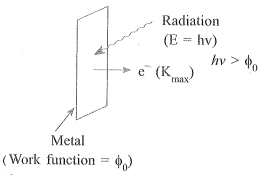
$\rightarrow $ When radiation is incident on a metal surface, the electrons in the metal interact with the quanta of the radiation. If the energy of quantum $( h v )$ is greater than the work function $\left(\phi_0\right)$ of a given metal, the electron absorbs this quantum. i.e. the full energy of the quantum $( h v )$ is absorbed and is emitted from the metal with a maximum kinetic energy $K _{\max }$.
Thus, $K _{ max }=h v-\phi_0$
$\rightarrow $ This equation is called Einstein's equation of photoelectric effect.
$\rightarrow $ If a photon interacts with an strongly bound electron than electron requires more energy to be ejected.
So it is emitted with less energy than $K _{\max }$.
Need a full question paper?
Generate a complete, print-ready paper with questions like this in minutes — across 16+ boards, with answer keys.