Discuss the nature of $C-X$ bond in the haloarenes.
CBSE DELHI - SET 3 2016
Download our app for free and get started
In haloarenes, $C-X$ bond acquires a partial double bond character due to resonance.
As a result, the bond cleavage in haloarene is difficult than haloalkane and therefore, they are less reactive towards nucleophilic substitution reaction.
In haloalkane, the carbon atom attached to halogen is $sp^3$ hybridised while in case of haloarene, the carbon atom attached to halogen is $sp^2-$hybridised.

The $sp^2$ hybridised carbon with a greater $s-$character is more electronegative and can hold the electron pair of $C-X$ bond more tightly than $sp^3$ hybridised carbon in haloalkane with less $s-$character.
Thus, $C-Cl$ bond$-$length in haloalkane is $177 \ pm$ while in haloarene is $169 \ Pm.$
As a result, the bond cleavage in haloarene is difficult than haloalkane and therefore, they are less reactive towards nucleophilic substitution reaction.
In haloalkane, the carbon atom attached to halogen is $sp^3$ hybridised while in case of haloarene, the carbon atom attached to halogen is $sp^2-$hybridised.
The $sp^2$ hybridised carbon with a greater $s-$character is more electronegative and can hold the electron pair of $C-X$ bond more tightly than $sp^3$ hybridised carbon in haloalkane with less $s-$character.
Thus, $C-Cl$ bond$-$length in haloalkane is $177 \ pm$ while in haloarene is $169 \ Pm.$

Download our appand get started for free
Experience the future of education. Simply download our apps or reach out to us for more information. Let's shape the future of learning together!No signup needed.*
Similar Questions
- 1View SolutionWrite the structures of the following organic halogen compound.
Perfluorobenzene. - 2Name the following halides according to $\text{IUPAC}$ system and classify them as alkyl, allyl, benzyl $($primary, secondary, tertiary$),$ vinyl or aryl halides: $\ce{(CH_3)_2CHCH(Cl)CH_3}$.View Solution
- 3Give the $\text{IUPAC}$ names of the following compound: $\ce{ClCH_2C≡CCH_2Br}$View Solution
- 4Write the structure of $3-$Bromo$-2-$methylprop$-1-$ene.View Solution
- 5View SolutionHow the following conversion can be carried out?
Benzyl alcohol to 2-phenylethanoic acid. - 6View SolutionWrite the IUPAC name of the following compound:
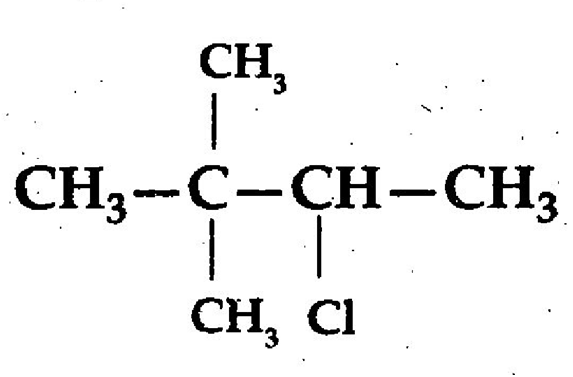
- 7Write the structure of the major organic product in each of the following reaction:View Solution
$\text{CH}_3\text{CH}=\text{C}(\text{CH}_3)_2+\text{HBr}\xrightarrow{}$ - 8Give the $\text{IUPAC}$ names of the following compound: $\ce{CH_3C(p-ClC_6H_4)_2CH(Br)CH_3}$View Solution
- 9Give the $\ce{IUPAC}$ names of the following compound: $\ce{CH_3CH(Cl)CH(Br)CH_3}$View Solution
- 10View SolutionWrite structures of the following compounds:
4-tert. Butyl-3-iodoheptane.