Question
Discuss the variation of mass with velocity.

Answer

By Einstein's theory of relativity $\text{m}=\frac{\text{m}_0}{\sqrt{1\frac{\text{v}_2}{\text{c}^2}}}$ = mass of moving body increases with velocity, because if v is increased $\Rightarrow\frac{\text{v}^2}{\text{c}^2}$ is increased. $\Rightarrow1-\frac{\text{v}^2}{\text{c}^2}\text{ is decreased }$ $\Rightarrow\frac{\text{m}_0}{\sqrt{1\frac{\text{v}^2}{\text{c}^2}}}\text{is increased}.$ If v is zero then $m = m_0$

Need a full question paper?

Generate a complete, print-ready paper with questions like this in minutes — across 16+ boards, with answer keys.
Start Generating Free

Similar questions

Answer the following: The mean diameter of a thin brass rod is to be measured by vernier callipers. Why is a set of 100 measurements of the diameter expected to yield a more reliable estimate than a set of 5 measurements only?
Calculate the fall in temperature of helium initially at 15°C, when it is suddenly expanded to 8 times of its volume. Given $\gamma=\frac53.$
Find the maximum kinetic energy of the photoelectrons ejected when light of wavelength 350nm is incident on a cesium surface. Work function of cesium = 1.9eV
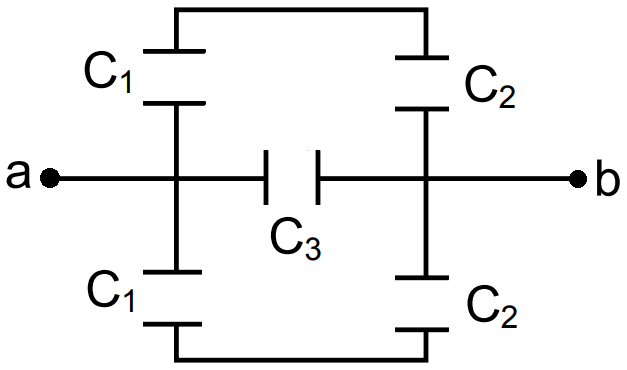
Find the equivalent capacitance of the syatem shown in figure between the points $a$ and $b$.
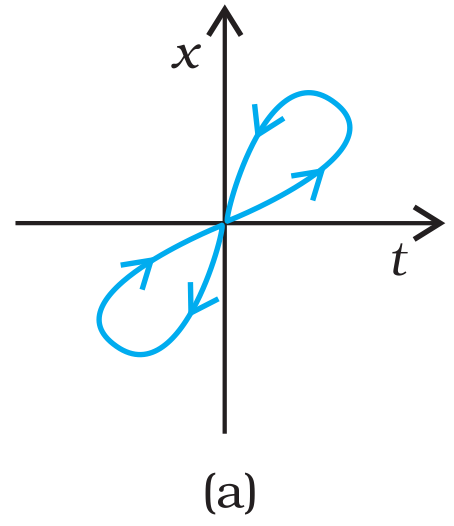
Look at the graphs carefully and state, with reasons, which of these cannot possibly represent one-dimensional motion of a particle.
Two cylinders A and B of equal capacity are connected to each other via a stopcock. A contains a gas at standard temperature and pressure. B is completely evacuated. The entire system is thermally insulated. The stopcock is suddenly opened. Answer the following: What is the final pressure of the gas in A and B?
A non-ideal battery is connected to a resistor. Is work done by the battery equal to the thermal energy developed in the resistor? Will your answer change if the battery is ideal?
Show graphically how g varies as you move from the centre of earth to great heights above the surface.
Convert:
i. $3.0 m / s ^2=$ __________ $km / hr ^2$
ii. $6.6710^{-11} Nm ^2 / kg ^2=$ __________ $g ^{-1} cm^3 s^{-2}$
What is the temperature at which all the gas molecule become immobile?