Question
Discuss the various types of positive interactions between species.

Answer

Following are the positive interactions between species:
  1. Mutualism: This is a relationship between two organisms in which both the organisms are benefitted. Lichen is a very good example of mutualism. Lichen is an association of fungi and algae. The fungal part attaches to the substratum and gets water and minerals for the algal part. The algal part carries out photosynthesis and provides food to the fungal part.
  2. Commensalism: This is a relationship between two organisms in which one organism is benefitted, while another organism is neither at gain nor at loss. Egrets keep on sitting on the back of herbivore animals; like buffalo, cow, etc. when the cattle forage for grass, the insects under the grass fly away haphazardly. This gives a chance to the egrets to feed on insects.

Need a full question paper?

Generate a complete, print-ready paper with questions like this in minutes — across 16+ boards, with answer keys.
Start Generating Free

Similar questions

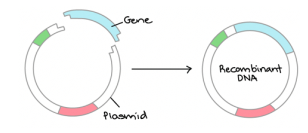
A vector is a way to take a sequence of DNA, usually, and introduce it into another place. So what vectors do is allow you to propagate the DNA you're interested in, in the organism you've chosen to propagate it in. So the simplest one is the origins of recombinant DNA technology: They made copies of RNAs, and they were able to insert these into what is known as plasmids.
Image
Unless the vector and source DNA are cut, fragments separated and joined, the desired recombinant vector molecule cannot be created.
i. How are the desirable DNA sequences cut?
ii. Explain the technique used to separate the cut fragments.
iii. How are the resultant fragments joined to the vector DNA molecule?
Explain the post pollination events up to double fertilisation, that occur in an angiosperm.
Bioreactors are the inclusion carriers in any biotechnology based production process. The ultimate success of any biotechnological technique depends on the efficiency of the bioreactor due to large scale production and economy.
In the context of the above passage, answer the following questions :
(i) For optimization of a bioreactor system, list possible operating instructions (rules). Make a list of any four.
(ii) "Optimal growth and metabolic activities of cells." Mention the stages of growth mentioned in.
(iii) Is the bioproduct formed in the bioreactor completely ready for immediate use as desired? Write the appropriate reasons also to support your answer.
Study the following flow chart. Name the hormones involved at each stage. Explain their functions.
Hypothalamus → Pituitary → Testes → Sperms.
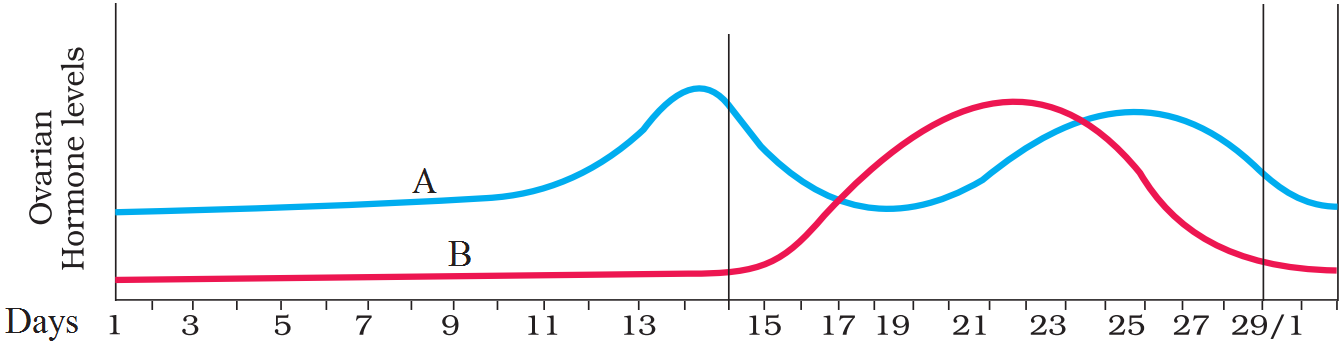
The graph given below shows the variation in the levels of ovarian hormones during various phases of menstrual cycle:

Compare the role of A and B.

Identify a, b and c in the table given below:
S. No.
Pattern of inheritance
Monohybrid F1 phenotypic expression
(i)
Co–dominance
a
(ii)
b
The progeny resembled only one of the parents.
(iii)
Incomplete dominance
c
A woman with blood group “A” marries a man with blood group “O”. Discuss the possibilities of the inheritance of the blood groups in the following starting with “yes” or “no” for each:
  1. They produce children with blood group “A” only.
  2. They produce children some with “O” blood group and some with “A” blood group.
Give an account of the methods used in sequencing the human genome.
(a) IVF is a very powerful method these days that is helping childless couples to bear a child. Describe the different steps that are carried out in this technique.
(b) Would you consider Gamete Intrafallopian transfer (GIFT) as on IVF? Give a reason in support of your answer.
Match the items in Column I with those in Column II.
S.No.
Column I
S.No.
Column II
(A)
Pyramid of energy
(i)
Phytoplanktons
(B)
Pyramid of biomass
(ii)
Mesic forest
(C)
Climax community
(iii)
Upright/ inverted
(D)
Hydrarch succession
(iv)
Alwayes upright
 
 
(v)
Pioneer species