MCQ
Dispersion can take place for
  • A
    Transverse waves only but not for longitudinal waves
  • B
    Longitudinal waves only but not for transverse waves
  • Both transverse and longitudinal waves
  • D
    Neither transverse nor longitudinal waves

Answer

Correct option: C.
Both transverse and longitudinal waves
c
Transverse and Longitudinal waves both can undergo dispersion provided the components constituting them have different velocities.

Need a full question paper?

Generate a complete, print-ready paper with questions like this in minutes — across 16+ boards, with answer keys.
Start Generating Free

Similar questions

When the speed of electrons increases, then the value of its specific charge
An electron is accelerated by a potential difference of $12000\, volts$. It then enters a uniform magnetic field of ${10^{ - 3}}\,T$ applied perpendicular to the path of electron. Find the radius of path. Given mass of electron $ = 9 \times {10^{ - 31}}\,kg$ and charge on electron $ = 1.6 \times {10^{ - 19}}\,C$
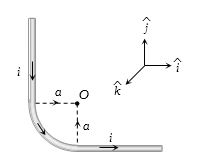
The unit vectors $\hat i,\;\hat j\;{\rm{and }}\,\hat k$ are as shown below. What will be the magnetic field at $O$ in the following figure
The maximum distance upto which $TV$ transmission from a $TV$ tower of height $h$ can be received is proportional to
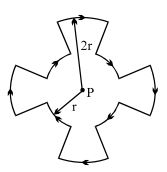
A current $I$ flows around a closed path in the horizontal plane of the circle as shown in the figure. The path consists of eight arcs with alternating radii $r$ and $2r$. Each segment of arc subtends equal angle at the common centre $P.$ The magnetic field produced by current path at point $P$ is
One $kg$ of water, at $20\,^oC$, is heated in an electric kettle whose heating element has a mean (temperature averaged) resistance of $20\, \Omega $. The rms voltage in the mains is $200\, V$. Ignoring heat loss from the kettle, time taken for water to evaporate fully, is close to.......... $\min$ [Specific heat of water $= 4200\, J/kg\, ^oC$), Latent heat of water $= 2260\, k\,J/kg$]
Molybdenum is used as a target element for production of X-rays because it is
Which series of hydrogen atom lie in infrared region?
If intensity of incident light is increased in PEE then which of the following is true
The voltage of an $ac$ source varies with time according to the equation $V = 100\sin \,\left( {100\pi t} \right)\cos \,\left( {100\pi t} \right)$ where $t$ is in seconds and $V$ is in volts. Then