Question
Distinguish between a clinical and a laboratory thermometer.

Answer

Difference between laboratory and clinical thermometer.
Laboratory thermometer Clinical thermometer
The range of temperature is high The range of temperature is low
It has no kink in it It has a kink (constriction) in it
It is used to measure the temperature of chemical reactions It is used to measure the human body temperature

Need a full question paper?

Generate a complete, print-ready paper with questions like this in minutes — across 16+ boards, with answer keys.
Start Generating Free

Similar questions

A motor bike, initially at rest, picks up a velocity of $72 kmh ^{-1}$ over a distance of 40 m . Calculate
1. acceleration
2. time in which it picks up above velocity.
Draw a velocity-time graph for the free fall of a body under gravity starting from rest. Take $g = 10m s^{-2}$
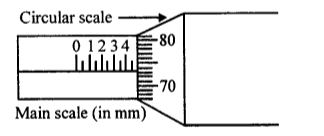
Figure shows a screw gauge in which circular scale has 100 divisions. Calculate the least count and the diameter of a wire.
Image
State two advantages and two limitations of Hydel Power.
State the volume changes that you will observe when a given mass of water is heated from 0°Cto 10°C. Sketch a temperature-volume graph to show the behaviour.
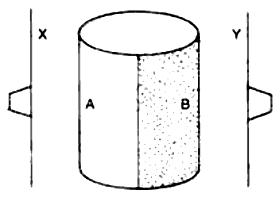
The following figure shows a metal cylinder, containing boiling water. One half side A is polished and another half, B is painted black. Two thin metal sheets X and Y are painted black and have one rubber stopper fixed with wax on each sheet. These sheets are equidistant from the boiling water (container A, B) as shown in the diagram. What would you expect to happen after a few minutes? Give a reason for your answer.
What do you mean by zero error of a screw gauge? How is it accounted for?
What do you meant by the term pole of a magnet? Magnetically speaking, what is the difference between a piece of brass, a piece of soft iron and a piece of lode-stone?
An object undergoes an acceleration of $8$ ms-2 starting from rest. Find the distance travelled in $5$ seconds.
State Newton's second law of motion. Is Newton's first law of motion contained in Newton's second law of motion?