Question
distinguish between: Ape and Human.

Answer

Ape:

  1. Brain of the apes is smaller in size.
  2. Ape cannot walk upright.
  3. Ape is less intelligent as compared to human.
  4. Apes are arboreal in their habitat and they spend more time on the trees.
  5. The forelimbs of ape are longer than the hind limbs.

Human:

  1. Brain of humans is larger in size.
  2. Humans can walk upright.
  3. Human is considered to be the most intelligent animal.
  4. Humans are terrestrial in their habitat. They cannot stay on the trees.
  5. The forelimbs of humans are shorter than the hind limbs.

Need a full question paper?

Generate a complete, print-ready paper with questions like this in minutes — across 16+ boards, with answer keys.
Start Generating Free

Similar questions

Name two properties of elements whose magnitudes change when going from top to bottom in a group of the periodic table. In what manner do they change?
Explain with a ray diagram the position, size, and nature of the various images formed by a convex lens.
Object at focus $F_1$
A convex lens of focal length $0.10m$ is used to form a magnified image of an object of height 5mm placed at a distance of $0.08m$ from the lens. Calculate the position, nature and size of the image.
What is lateral inversion? Explain by giving a suitable example.
 How can the soil polluted by acid rain be made fertile again?
An object 50cm tall is placed on the principal axis of a convex lens. Its 20cm tall image is formed on the screen placed at a distance of 10cm from the lens. Calculate the focal length of the lens.
When a piece of limestone reacts with dilute HCl, a gas X is produced. When gas X is passed through lime water then a white precipitate Y is formed. On passing excess of gas X, the white precipitate dissolves forming a soluble compound Z.
  1. What are X, Y and Z?
  2. Write equations for the reactions which take place:
  1. When limestone reacts with dilute HCl.
  2. When gas X reacts with lime water to form white precipitate Y.
  3. When excess of gas X dissolves white precipitate Y to form a soluble compound Z.
i. What are vitamins?
ii. Classify them according to their solubility.
iii. Give one example of each type as per above classification.
${ }_1 H ,{ }_7 N,{ }_{20} Ca ,{ }_{16} S,{ }_4 Be ,{ }_{18} Ar$. Which of these elements belong to the second group?
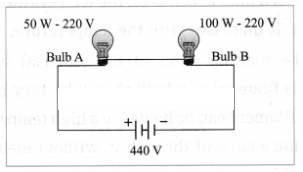
Observe the following figure. Which bulb will fuse? (Practice Activity Sheet – 4)

Image