Question
Distinguish between: Blastula and Gastrula ### Give two differences between blastula and gastrula.

Answer

BlastulaGastrula
1. Blastula is formed from morula on 7th day after fertilization.1. Gastrula is formed from blastula 15 days after fertilization.
2. Blastula has a blastocoel.2. Gastrula has a gastrocoel or archenteron.
3. Blastula is produced by the process of blastulation.3. Gastrula is produced by the process of gastrulation.
4. Blastula undergoes implantation followed by gastrulation.4. Gastrula undergoes morphogenesis and then forms germs layers.
5. During blastula formation there is no movement of cells.5. Gastrula formation results from the morphogenetic movement of cells.

Need a full question paper?

Generate a complete, print-ready paper with questions like this in minutes — across 16+ boards, with answer keys.
Start Generating Free

Similar questions

Read the following and answer any four questions from (i) to (v) given below:
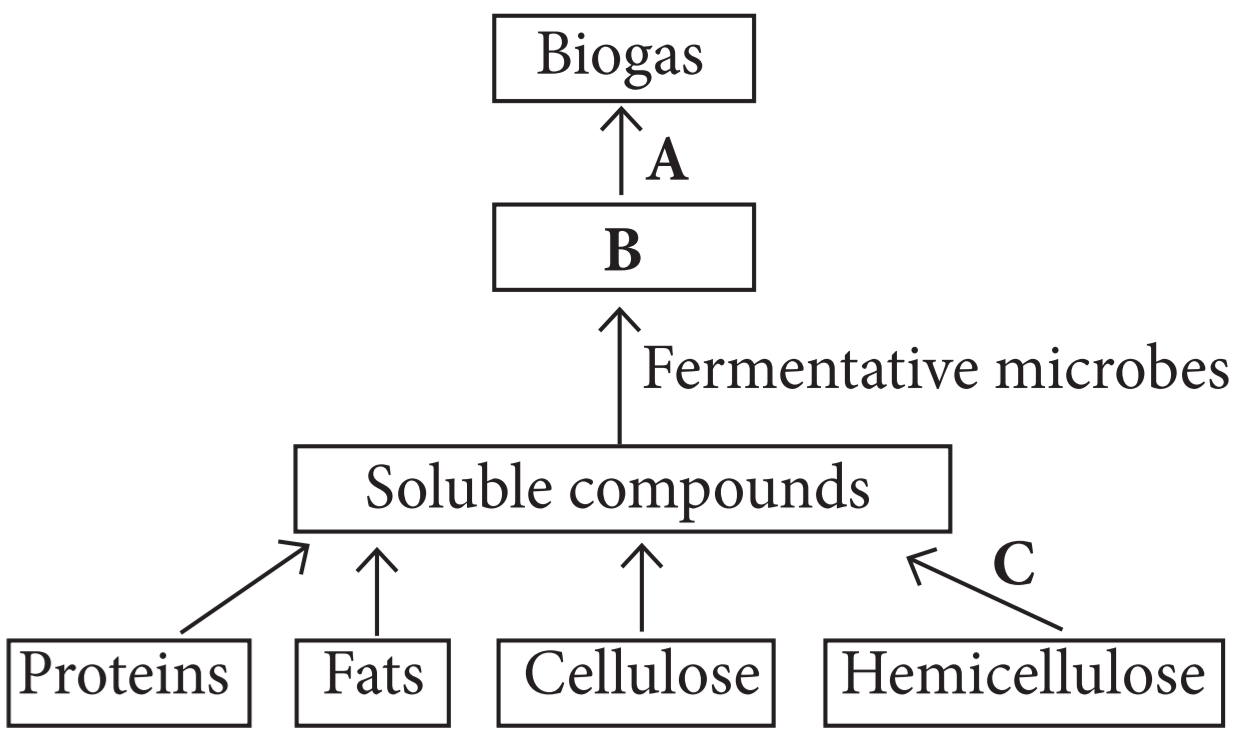
Villagers in a place near Chambur started planning to make power supply for agricultural purposes from cow dung. 'Tiley have started a biogas plant for the purpose. Study the flow chart for biogas production given below and answer the following questions.
  1. Biagas is composed of majorly:
  1. Methane, $CO_2$ and $O_2$​​​​​​​
  2. $CO_2, H_2S$ and H
  3. Methane, $CO_2​​​​​​​$
  4. $H_2S, H$ and $O_2​​​​​​​$
  1. In the given flow chart, 'A' denotes:
  1. Aerobic bacteria.
  2. Methanogenic bacteria.
  3. Cellulose degrading bacteria.
  4. Yeast and protozoa.
  1. What is represented by 'B' in the flow chart?
  1. Carbohydrates.
  2. Protein polymers.
  3. Organic acids.
  4. Fat globules.
  1. 'C' in the given flow chart causes:
  1. Aerobic breakdown of complex organic compounds.
  2. Anaerobic digestion of complex organic compounds.
  3. Fermentation of organic compounds.
  4. Fermentation of monomers.
  1. If 'A' is not added in the procedure.
  1. Methane will not be formed.
  2. $CO_2​​​​​​​$​​​​​​​ will not be formed.
  3. Organic compounds will not be converted to $H_2S$
  4. $O_2​​​​​​​$ will not be formed.
Genomic library and c-DNA library.
Read the following and answer any four questions from (i) to (v) given below:
A typical angiospermic ovule is a small structure attached to the placenta by means of a stalk called funicle. The body of the ovule fuses with funicle in the region called hilum. Each ovule has one or two protective envelopes called integuments. Integuments encircle the nucellus except at the tip where a small opening called the micropyle is formed. Mature ovules are classified on the basis of funiculus. It can be orthotropous, anadromous, hernitropous, campylotropous, etc.
  1. The body of the ovule consists of a mass of parenchymatous cells called:
  1. Integuments.
  2. Nucellus.
  3. Hilum.
  4. Funiculus.
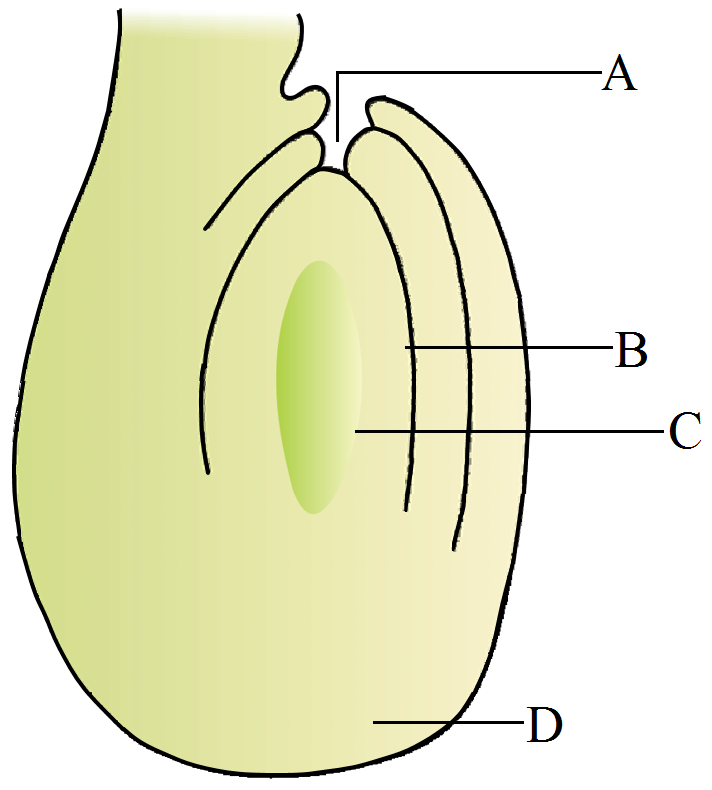
  1. Refer to the given figure and select the correct statement regarding it.
  1. This type of ovule is found in cactus.
  2. The micropyle comes to lie close to the funiculus due to unilateral growth of ovule.
  3. It is most common type of ovule found in the members of Chenopodiaceae.
  4. It is half inverted ovule.
  1. Identify the parts labelled as A, B, C and D in the given figure and select the correct option.
S. No A B C D
(a) Chalaza Female gametophyte Embryo sac Micropyle
(b) Chalaza NuceIIus Embryo sac Micropyle
(c) Micropyle Egg Embryo sac Chalaza
(d) Micropyle Nucellus Embryo sac Chalaza
  1. Mature ovules are classified on the basis of funiculus. If micropyle lie close to the funiculus, the ovule is termed as:
  1. Orthotropous.
  2. Anatropous.
  3. Hemitropous.
  4. Campylotropous.
  1. In Asphodel us, ovule is:
  1. Unitegmic.
  2. Tritegmic.
  3. Bitegmic.
  4. Ategmic.
Distinguish between: Primary sex organs and Secondary sex organs.
Eurythermal and stenothermal.
Germ line gene therapy and somatic cell gene therapy.
Distinguish between : Epithalamus and hypothalamus.
Column AColumn B
(1) Walter Rosen(a) Popularisation of term biodiversity
(2) David Tillman(b) Rivet Popper Hypothesis
(3) Paul Ehrlich(c) Productivity Stability Hypothesis
(4) Edward Wilson(d) Coined
Read the following and answer any four questions from (i) to (v) given below:
According to Mendel, one gene control the expression of one character only. The ability of a gene to have multiple phenotypic effect because it influences a number of characters is an exception. The gene having a multiple phenotypic effect because of its ability to control of two or more characters can be seen in cotton. In cotton, a gene for the lint also influences the height of plant, size of the ball, number of ovules and viability of seeds.
  1. Genes with multiple phenotypic effects are known as?
  1. Hydrostatic genes.
  2. Duplicate genes.
  3. Pleiotropic genes.
  4. Complimentary genes.
  1. Which of the following disorder is an example of genes with multiple phenotypic effects?
  1. Phenylketonuria.
  2. Haemophilia.
  3. Sickle cell anaemia.
  4. Both (a) and (c)
  1. Which of the following is an example of gene with multiple phenotypic effect?
  1. Drosophila white eye mutation.
  2. Kernel colour in wheat.
  3. Height in human beings.
  4. Skin colour in human beings.
  1. Which of the following statements is not correct regarding genes with multiple phenotypic effect?
  1. It is not essential that all the traits are equally influenced.
  2. Occasionally a number of related changes are caused by a gene.
  3. It occurs due to effect of the gene on two or more inter-related metabolic pathways.
  4. None of these.
  1. Assertion: ln garden pea, the gene which controls the flower colour also controls the colour of the seed coat and presence of red spots in the leaf axils.
Reason: A pleiotropic gene influences more than one trait.
  1. Both assertion and reason are true and reason is the correct explanation of assertion.
  2. Both assertion and reason are true but reason is not the correct explanation of assertion.
  3. Assertion is true but reason is false.
  4. Both assertion and reason are false.
Distinguish Between: Homozygous and Heterozygous.