Question
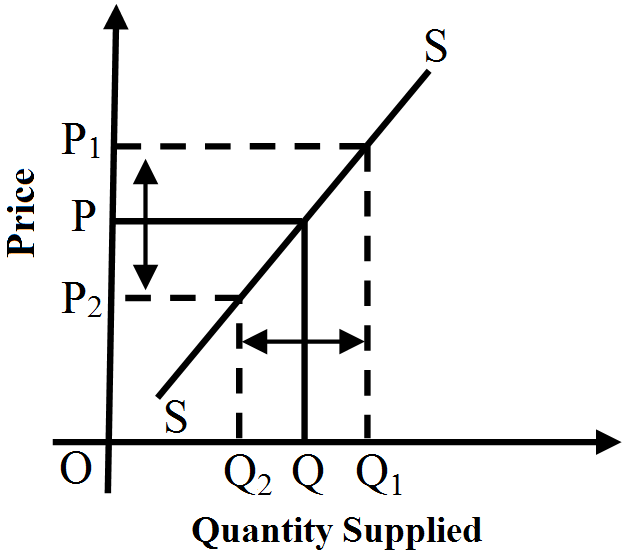
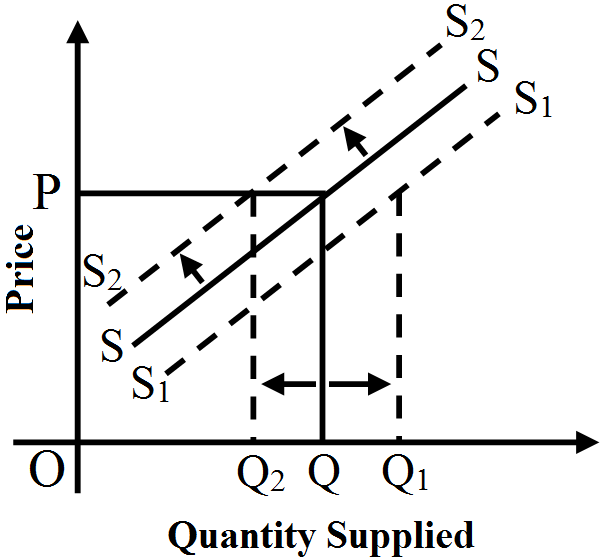
Distinguish between change in quantity supplied and change in supply. Use diagram.

Answer

Basis
Changes in quantity supplied
Change in supply
Meaning
The change in quantity supplied due to the change in price of the commodity.
Change in supply due to the change in factors other than price.
Alternative name
Movement along the supply curve:
Shift in supply curve:
(i) Expansion in supply.
(i) Increase in supply.
(ii) Contraction in supply.
(ii) Decrease in supply.
Meaning
(i) It states that rise in quantity supplied due to the rise in price of the commodity.
(i) An increase in supply means that producers now supply more at a given price level.
(ii) It states that fall in quantity supplied due to the fall in price of the commodity.
(ii) A decrease in supply means that producers now supply less at a given price level.
Schedule
Expansion
Contraction
Price
Supply
Price
Supply
2
4
8
10
4
2
10
2
Increase
Decrease
Price
Supply
Price
Supply
4
4
8
10
4
4
10
8
Diagrams

Need a full question paper?

Generate a complete, print-ready paper with questions like this in minutes — across 16+ boards, with answer keys.

Start Generating Free

Similar questions

Complete the following table:
Output units
Total cost Rs.
Average variable cost Rs.
Marginal cost Rs.
Average fixed cost Rs.
0
30


1
---
---
20
---
2
68
---
---
---
3
84
18
---
---
4
---
---
18
---
5
125
19
---
6
Market for a product is in equilibrium. Supply of the product "decreases." Explain the chain of effects of this change till the market again reaches equilibrium. Use diagram.
Show the behaviour of AC when AVC per unit of output is constant.
Distinguish between a centrally planned economy and a market economy.
Distinguish between inferior good and normal good. Explain the effect of change in income on the demand curve of each good. Use diagram.
OR
Distinguish between normal goods and inferior goods, with examples.
From the following information about a firm, find the firm’s equilibrium output in terms of marginal cost and marginal revenue. Give reasons. Also, find profit at this output.
Output
(units)
Total Revenue
(₹)
Total Cost
(₹)
1 6 7
2 12 13
3 18 17
4 24 23
5 30 31
Find out (a) explicit cost and (b) implicit cost from the following data:
S No
 
 
1.
Investment in fixed assets
(Rs Thousand)
2.
Borrowings at 12% interest per annum.
2000
3.
Wages paid during the year
1500
4.
Annual rental value of the owner's factory building
120
5.
Annual depreciation
100
6.
Estimated annual value of the management services of the owner
100
For a consumer to be in equilibrium why must marginal rate of substitution be equal to the ratio of prices of the two goods?
OR
Using indifference curve approach, explain the conditions of consumer's equilibrium.
OR
Why is the consumer in equilibrium when he buys only that combination of the two goods that is shown at the point of tangency of the budget line with an indifference curve? Explain.
OR
What are the conditions of consumer's equilibrium under the indifference curve approach? What changes will take place if the conditions are not fulfilled to reach equilibrium?
OR
State and explain the conditions of consumer's equilibrium in indifference curve analysis.
OR
Explain consumer equilibrium using the concept of budget line and indifference map or Interior Optimum Consumer Equilibrium.
OR
A consumer consumes only two of goods. For the consumer to be in equilibrium why must Marginal Rate of Substitution between the two goods must be equal to the ratio of prices of these two goods? Is it enough to ensure equilibrium?
OR
A consumer consumes only two goods. Explain the conditions that need to be satisfied for the consumer to be in equilibrium under indifference curve analysis.
OR
Show diagrammatically the conditions for consumer's equilibrium, in Hicksian analysis of demand.
OR
Explain the conditions of consumer's equilibrium under indifference curve approach.
Explain with the help of a diagram the effect of the following changes on the demand of a commodity.
  1. A fall in the price of substitute good.
  2. A fall in the income of its buyer.
If the demand curve of a commodity shifts to the right and the supply curve shifts to the left, what will be the effect on equilibrium price and quantity? Illustrate with a diagram.