Question
Distinguish between Current Ratio and Quiek Ratio.

Answer

Distinction between Current Ratio and Quick Ratio
Basis of Distinction
Current Ratio
Quick Ratio(or Liquid Ratio)
1.
Relationship
It establishes a relationship between current Assest and Current Liabilities.
It establishes a relationship between Liquid Assets and Current Liabilities.
2.
Formula for computation
Current Ratio $=\frac{\text{Current Assets}}{\text{Current Liabilities}}$ Quick Ratio $=\frac{\text{Liquid Assets}}{\text{Current Liabilities}}$
3.
Obejctive
It measures the ability of the firm to meet its current liabilities within 12 months from the date of balance Sheet or within the period of operting cycle.
It measures the ability of the firm to meet its current liabilities immediately or within a month.
4.
Ideal Ratio
Current Ratio of 2 : 1 is Considered as an ideal ratio.
Quick Ratio of 1 : 1 is Considered as an ideal ratio.
5.
True Measurement
It is not a true measurement of short-term financial position of the firm as it may include a large amount of inventoires which may not be quickly convertible in to cash.
It removes this shortcoming of current ratio by excluding the amount of inventories.
 

Need a full question paper?

Generate a complete, print-ready paper with questions like this in minutes — across 16+ boards, with answer keys.
Start Generating Free

Similar questions

On $1st$ April, $2012$ a Limited Company issued $10 \%$ Debentures of the face value of $₹ 1,20,000$ at a discount of $6 \%$. The debentures are repayable by annual drawings of $₹ 40,000$ commencing from the end of $3^{\text {rd }}$ year. How will you deal with discount on debentures?
Show the discount on issue of debentures account in the Company's ledger for the period of duration of debenture. Assume that the accounts are closed on $31^{\text {st }}$ March each year.
From the following information, prepare comparative statement of profit and loss showing increase, decrease and percentage:
Following information is given about a company:
 
Revenue from Operations, i.e., Net Sales.
1,50,000
Gross Profit.
30,000
Cost of Revenue from Operations (Cost of Goods Sold).
1,20,000
Opening inventory.
29,000
Closing Inventory. 31,000
Debtors. 16,000
From the above information, calculate following ratios:
  1. Gross Profit Ratio,
  2. Inventory Turnover Ratio, and
  3. Trade Receivables Turnover Ratio.
Under what heads will you classify the following items on the equity and liability side of the Balance Sheet of a limited company:
  1. Unclaimed Dividend.
  2. Proposed Dividend.
  3. Securities Premium Reserve.
  4. Share Forfeited Account.
  5. Public Deposits.
  6. Debentures.
  7. Bills discounted but not matured.
X.Ltd. issued 15,000, 10% debentures of ₹ 100 each. Give journal entries and the Balance Sheet in each of the following cases:
  1. The debentures are issued at a premium of 10%.
  2. The debentures are issued at a discount of 5%.
  3. The debentures are issued as a collateral security to bank against a loan of ₹ 12,00,000; and
  4. The debentures are issued to a supplier of machinery costing ₹ 13,50,000.
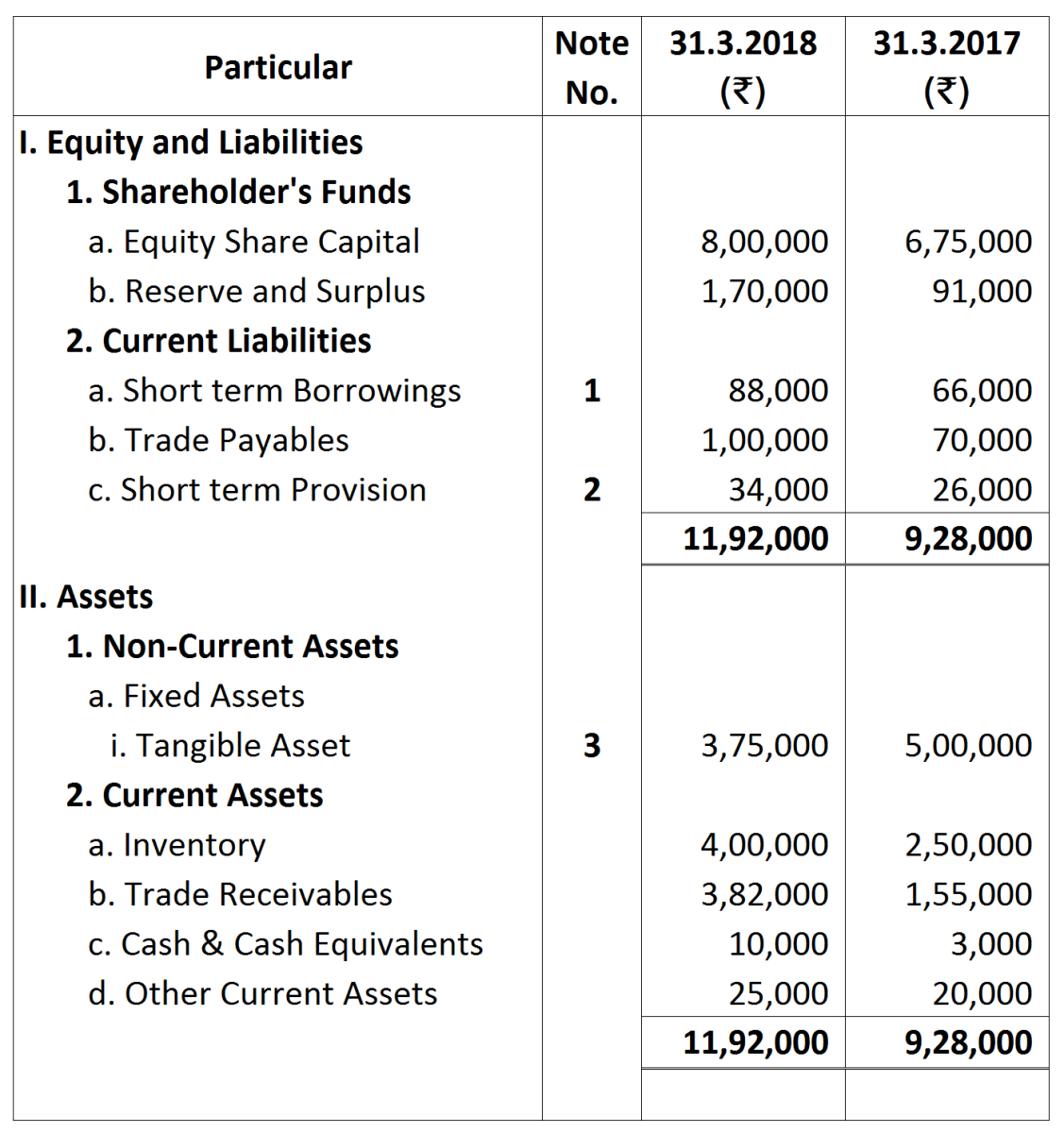
From the following Balance Sheets of XLtd., you are required to prepare Cash Flow Statement. Notes:
1.
Short-term Borrowings:
31.3.2018
31.3.2017
 
Bank Overdraft
88,000
66,000
2.
Short-term Provision


Taxation Provision
34,000
26,000
3
Tangible Assets:


Land
1,50,000
2,00,000
 
Plant
2,25,000
3,00,000
 
 
3,75,000
5,00,000
Additional Information:
  1. Interim Dividend paid during the year ₹ 60,000
  2. Land was sold at a profit of ₹ 30,000
  3. Plant costing ₹ 20,000 was sold during the year at a loss of ₹ 8,000.
Mahesh Ltd. had issued $20,000, 10\%$ debentures of ₹ $100$ each. $8,000, 10\%$ debentures were due for redemption on $31^{st}$ March, $2019$. The company had a balance of ₹ $4,40,000$ in the Debenture Redemption Reserve Account on $31^{st}$​​​​​​​ March, $2018$. The company invested the required amount in the Debenture Redemption Investment on $1^{st}$​​​​​​​ April, $2018$.
Pass the necessary journal entries for redemption of debentures. Ignore the entries for interest on debentures.
The current ratio of a company is 2.5 : 1. Which of the following suggestions would improve, reduce and not change it?
  1. Payment to trade payables.
  2. Sell machinery against chque.
  3. Sale oflnventory at loss against Cehque.
  4. Cash collected from trade receivables.
  5. B/R dishonoured.
  6. Issue of shares.
  7. Issue of shares against the purchase of a building.
  8. Redemption (Repayment) of Debentures.
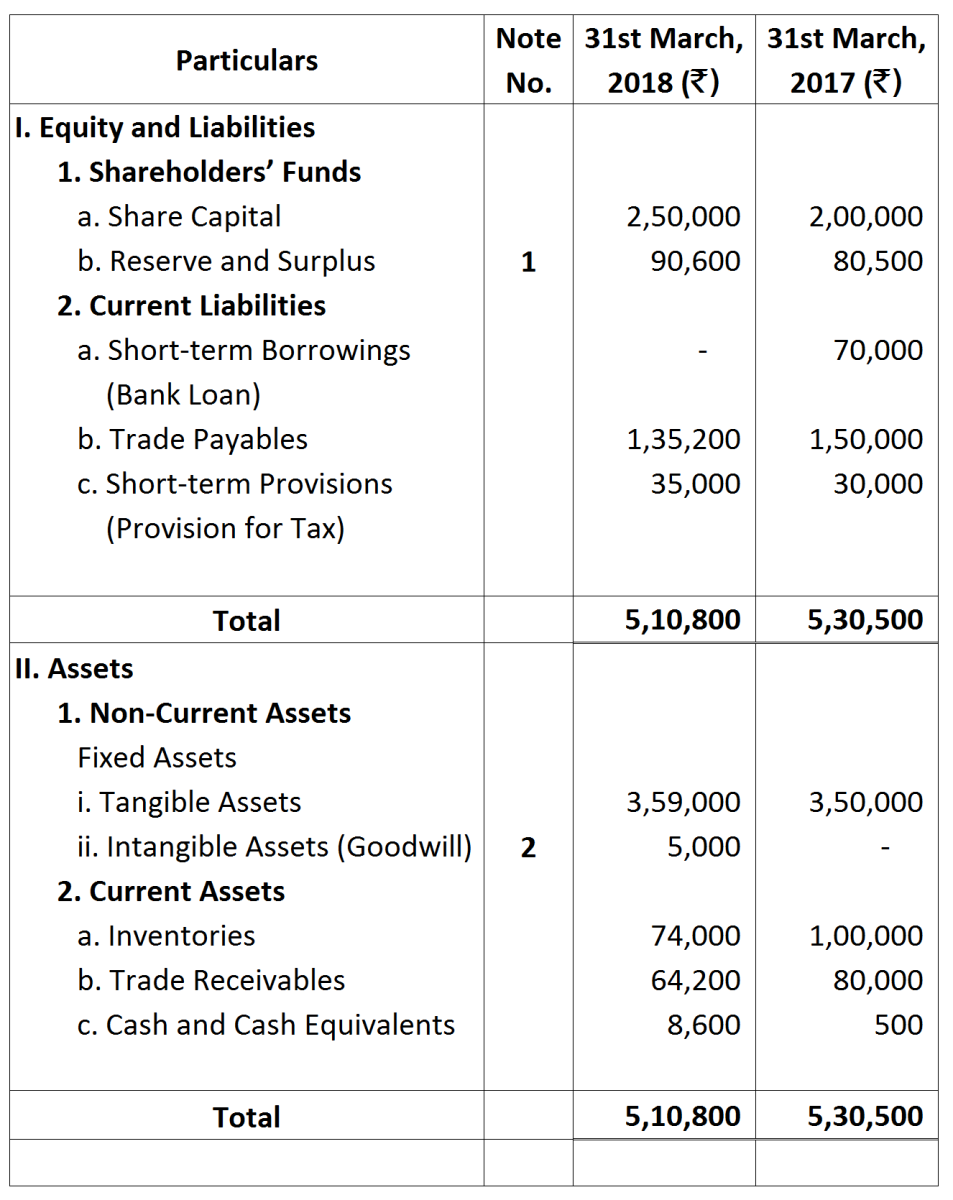
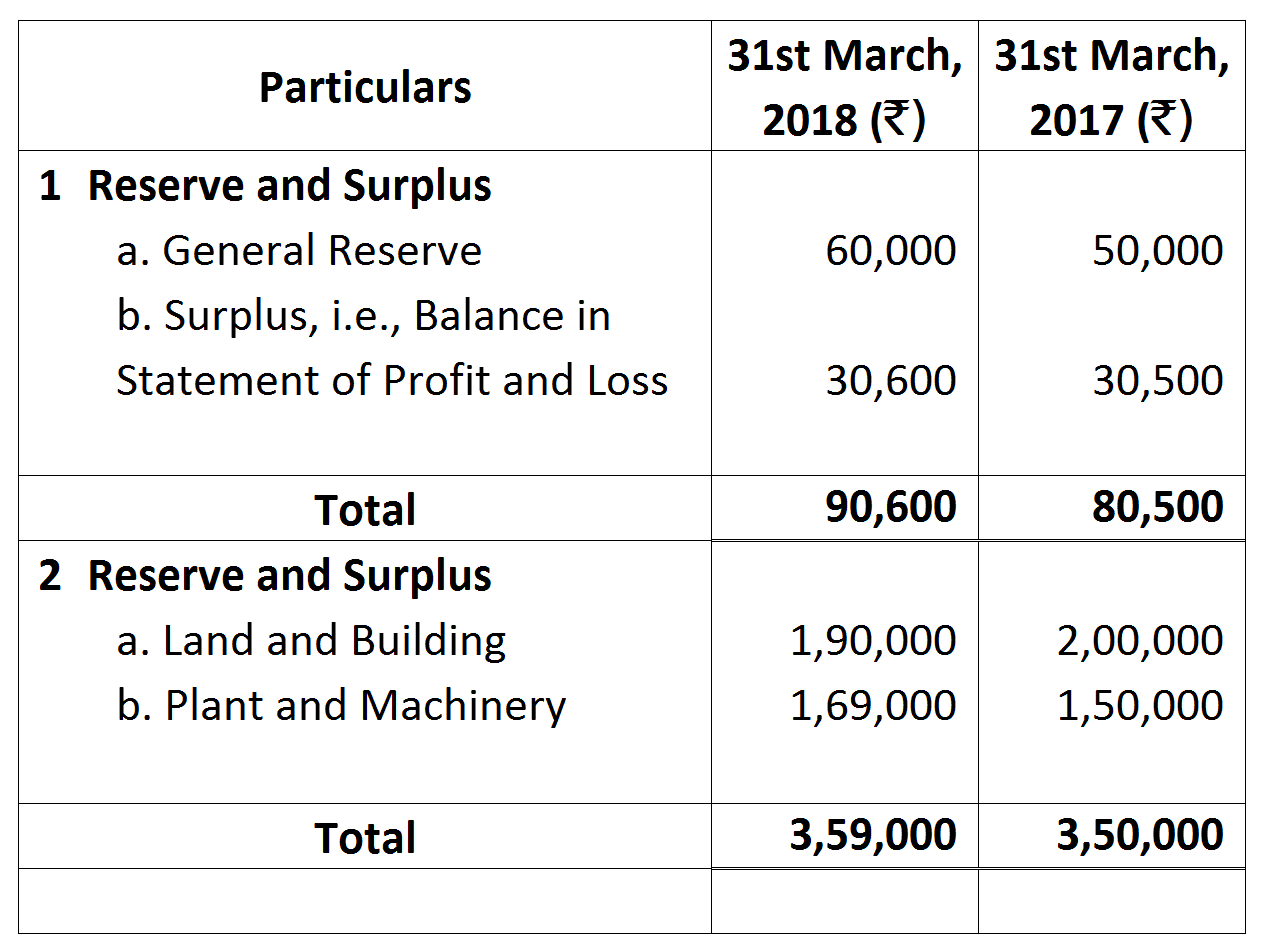
From the following Balance Sheet, prepare Cash Flow Statement: Notes to accounts:
Additional Information:
  1. Proposed Dividend for the year ended 31st March, 2018 was ₹ 25,000 and for the year ended 31st March, 2017 was ₹ 14,000.
  2. Interim Dividend paid during the year was ₹ 9,000.
  3. The Income Tax paid during the year ₹ 28,000.
  4. Machinery was purchased during the year ₹ 33,000.
  5. Depreciation written off on machinery ₹ 14,000; building ₹ 10,000.
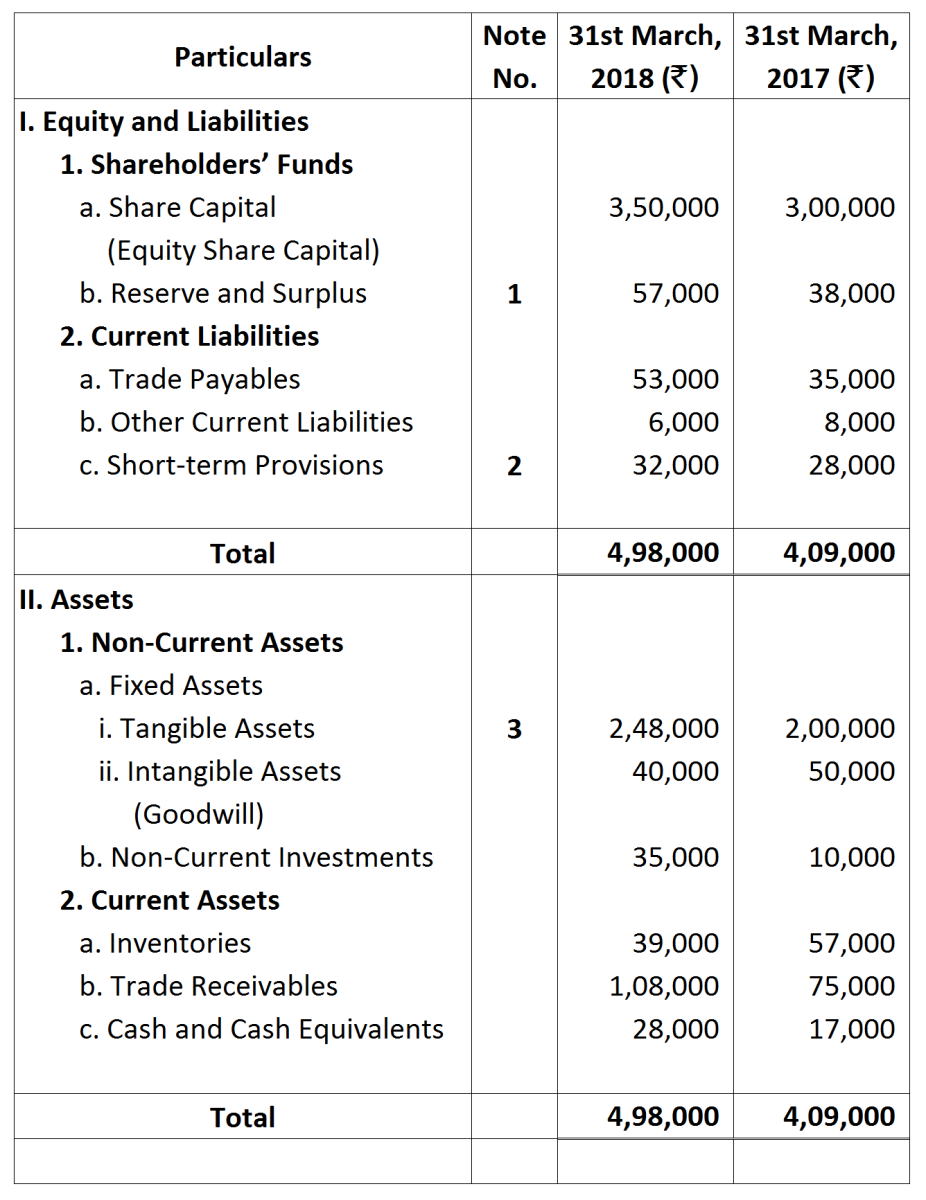
Following is the Balance Sheet of BPL Ltd. as at 31st March, 2018. Notes to Accounts:

Note: Proposed equity dividends for the year ended 31st March, 2017 and 2018 are ₹ 39,000 and ₹ 45,000 respectively. You are required to prepare Cash Flow Statement for the year ended 31st March, 2018.