Question
Distinguish between decrease in demand and decrease in quantity demanded.

Answer

S. No.
Basis
Decrease in demand
Decrease in quantity demanded
1.
Cause
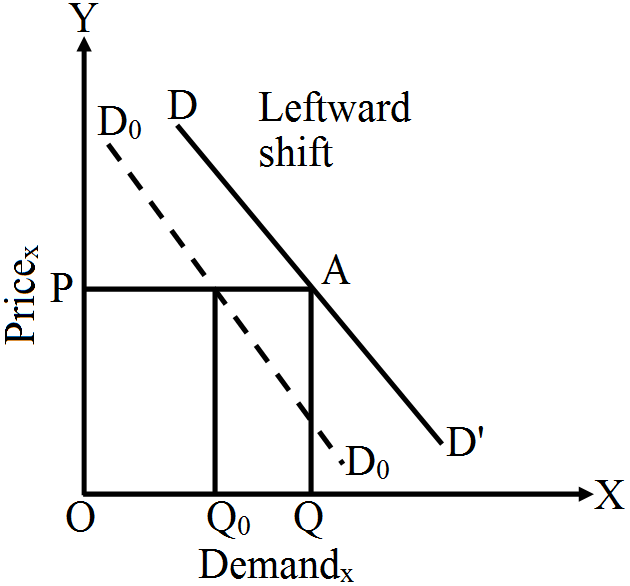
Decrease in demand is due to change in factor other than price of the given good-e.g. decrease in income, unfavourable change in tastes etc.
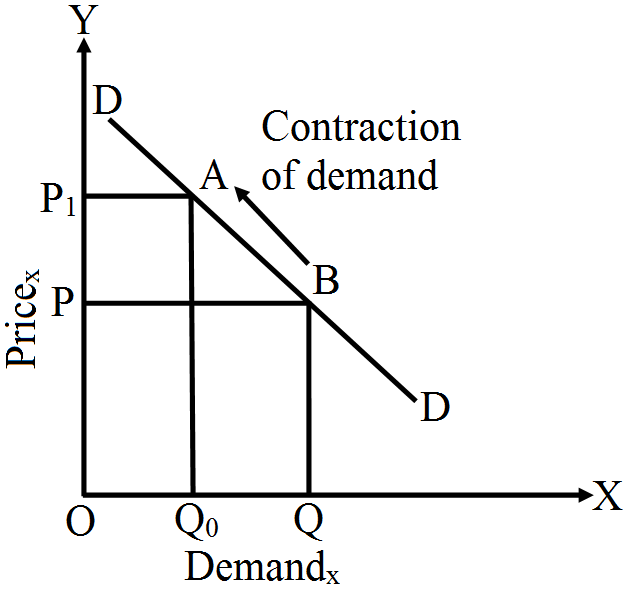
Decrease in quantity demanded is due to rise in own price of the given commodity.
 
2.
Demand curve
Decrease in demand leads to "leftward shift" of the demand curve from DD' to D0D0.
Decrease in quantity demanded leads to "upward movement” along a demand curve from point B to point A.
3.
Diagram

Need a full question paper?

Generate a complete, print-ready paper with questions like this in minutes — across 16+ boards, with answer keys.

Start Generating Free

Similar questions

Give the behaviour of marginal product and total product as more and more units of only one input are employed while keeping other inputs as constant.
Distinguish between:
  1. Capital receipts and revenue receipts.
  2. Direct tax and indirect tax.
We suppose that C = 70 + 0.70Y D, I = 90, G = 100, T = 0.10Y.
  1. Find the equilibrium income.
  2. What are tax revenues at equilibrium income?
Does the government have a balanced budget?
From the following data calculate: (a) Private income, and (b) Personal disposable income:
S.No.   Rs. (in crores)
1 Income from domestic product accuring to the private sector. 4,000
2 Saving of non-departmental public entreprises. 200
3 Current transfers from government administrative departments. 150
4 Saving of private corporate sector. 400
5 Current transfers from rest of the world. 50
6 Net factor income from abroad. -40
7 Corporation tax. 60
8 Direct personal taxes. 140
An economy is in equilibrium. Calculate national Income from the following:
Autonomous consumption = 100
Marginal propensity to save = 0.2.
Investment expenditure = 200.
What is ‘change in supply’? Explain the effect of tax imposed on a good on the supply of the good.
Find out average variable cost in:
Total Output
(Units)
Total Cost (Rs)
0
120
1
180
2
200
3
210
4
230
5
270
6
360
Read the passage given below and answer the following questions from 1 to 4.
In the Government of India's budget for the year 2013 - 14, the Finance Minister proposed to raise the Goods and Services Tax (GST) on cigarettes. He also proposed to increase income tax on individual earning more than rupee one crore per annum.
  1. Identify the taxes proposed to be increased by the Budget 2013 - 14. The taxes proposed are:
  1. Goods and Services tax on cigarettes.
  2. Income tax on individuals earning Rs. 1 crore or above.
  3. Both [a] and [b]
  4. None of the above
  1. What was the objective(s) behind the proposals put forth in the Budget 2013 - 14?
  1. Revenue generation
  2. Social welfare
  3. Both [a] and [b]
  4. None of these
  1. What welfare objective the government wishes to achieve by increasing GST on cigarettes?
  1. This will discourage their cigarettes
  2. This will encourage their cigarettes
  3. Both [a] and [b]
  4. None of the above
  1. What would be the effect of increase in direct tax on the rich?
  1. It will reduce the gap between rich and the poor, thereby reducing inequalities in income
  2. It will increase the gap between rich and the poor
  3. Both [a] and [b]
  4. None of the above
Define utility. Explain the Law of Diminishing Marginal Utility.
An economy is in equilibrium. Find Marginal Propensity to Consume from the following:
National income = 2000
Autonomous consumption = 400
Investment expenditure = 200