Question
Distinguish between electrolytic methods of reduction and refining ?

Answer

Electrolytic Reduction
(i) It is removal of oxide or halide from a metal.
(ii) Oxides of highly active metals like Na,K,Ca,Mg,Al are reduced by electrolytic reduction of their fused salts.
(iii) Oxides of these metals have great affinity for oxygen than carbon and cannot be reduced by carbon or CO or hydrogen.
Electrolytic refining of metals is the separation of residual impurities like Si and phosphorus.
(i) Presence of other metals and non-metals like Si and phosphorus.
(ii) Unreduced oxides and sulphides of metals.
It depends upon:
(i) Nature of metal
(ii) Purpose for which metal is to be obtained.
(iii) Nature of impurities present.
Impure metal is made anode while a thin sheet of pure metal is made cathode and electrolyte used is a salt of solution of a metal to be refined.

Need a full question paper?

Generate a complete, print-ready paper with questions like this in minutes — across 16+ boards, with answer keys.

Start Generating Free

Similar questions

If the empirical formula of two compounds is CH and their Vapour densities are 13 to 39 respectively, find their molecular formula.
$112 cm^3$ of $H_2S(g)$ is mixed with $120 cm^3$ of $Cl_2(g)$ at STP to produce $HCl(g)$ and sulphur(s). Write a balanced equation for this reaction and calculate (i) the volume of gaseous product formed (ii) composition of the resulting mixture.
Solid ammonium dichromate decomposes as:
$\left( NH _4\right)_2 Cr _2 O _7 \longrightarrow N _2+ Cr _2 O _3+4 H _2 O$
If $63 g$ of ammonium dichromate decomposes. Calculate what will be the loss of mass?
Two oxides of a metal $(M)$ have $20.12\%$ and $11.19\%$ oxygen. The formula of the first oxide is $MO$. Determine the formula of the second oxide.
Copy and complete the following table.
Column 3 has the names of gases to be prepared using the substance you enter in column 1, along with dilute or concentrated sulphuric acid, as indicated in column 2.
Column 1Column 2Column 3
Substance reacted with acid Dilute or concentrated sulphuric acidGas
Hydrogen
Carbon dioxide
Only chlorine
Write the equation for the laboratory preparation of :
(i) Sodium sulphate using dilute sulphuric acid.
(ii) Lead sulphate using dilute sulphuric acid.

Name the common refrigerant. How does it deplete the ozone layer?
Give three reactions to show reducing property of ammonia.
Hydrogen chloride gas is very soluble in water. It is dissolved in water to prepare hydrochloric acid by using an anti-suction device, as shown in the diagram. Very briefly explain how this device prevents the suction of water into the flask, in which hydrogen chloride gas is produced.
X is an element in the form of a powder. X burns in oxygen and the product is soluble in water. The solution is tested with litmus. Write down only the word which will correctly complete each of the following sentences:
(a) If X is a metal, then the litmus will turn ______.
(b) If X is a non-metal, then the litmus will turn ______.
(c) If X is a reactive metal, then ______ will be evolved, when X reacts with dilute sulphuric acid.
(d) If X is a non -metal, it will form _ oxide, which will form ______ solution with water.
(e) If X is a non -metal, it will not conduct electricity unless it is carbon in the form of ______.
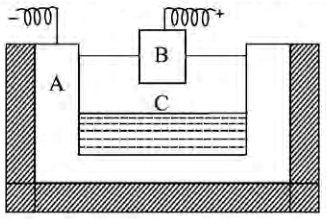
The following is a sketch of an electrolytic cell used in the extraction of aluminium:
Image
(i) What is the substance of which the electrodes A and B are made?
(ii) At which electrode (A or B) is aluminium formed?
(iii) What are the two aluminium compounds in the electrolyte C?
(iv) Why is it necessary for electrode B to be continuously replaced?