Question
Distinguish between increase in demand and increase in quantity demanded of a good.

Answer

S. No.
Basis
Increase in demand
Increase in quantity demanded
1.
Cause
Increase in demand is due to change in factors other than price of the given good e.g. increase in income, favourable change in tastes etc.
Increases in quantity demanded is due to fall in the own price of the given commodity.
2.
Demand curve
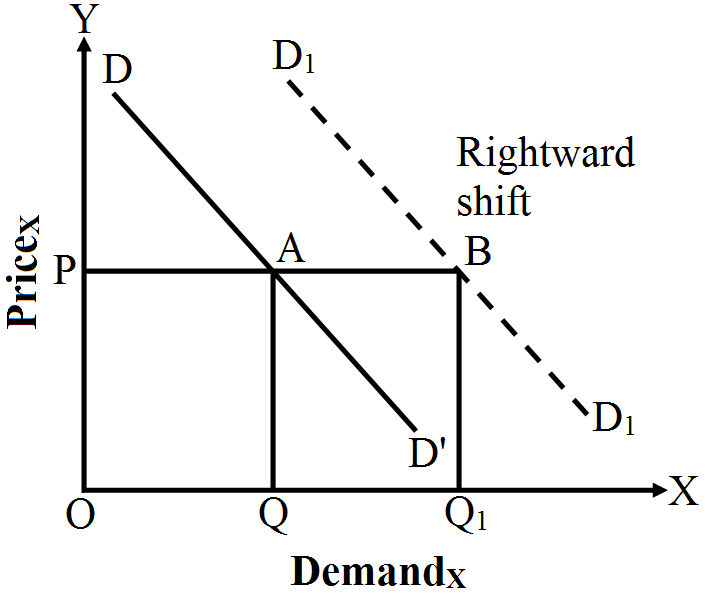
Increase in demand leads to "rightward shift” of the demand curve from DD' to D1D1.
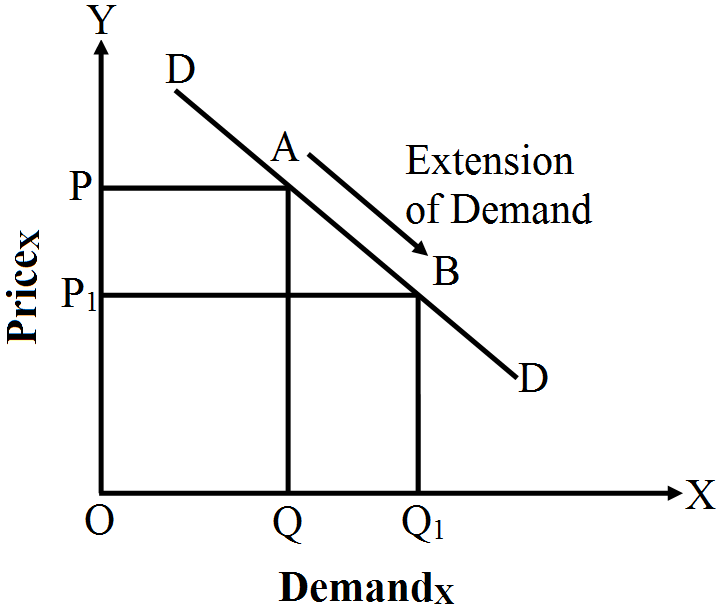
Increase in quantity demanded leads to “downward movement” along a demand curve from point A to point B.
3.
Diagram

Need a full question paper?

Generate a complete, print-ready paper with questions like this in minutes — across 16+ boards, with answer keys.

Start Generating Free

Similar questions

Draw the average revenue curve of a firm under (1) monopoly and (2) perfect competition. Explain the difference in these curves, if any.
What is ex-Ante consumption? Distinguish between autonomous consumption and induced consumption.
Giving reasons, explain whether the following are included in National Income:
  1. Profits earned by a branch of foreign bank.
  2. Interest paid by an individual on a loan taken to buy a car.
  3. Expenditure on machines for installation in a factory.
Explain any two causes of a rightward shift of supply curve.

OR

Explain any two causes of 'increase in supply of a commodity.

Total Revenue at a price of 34 per unit of a commodity is ₹ 480. Total Revenue increases by ₹ 240 when its price rises by 25%. Calculate its Price Elasticity of Supply.
The following table shows the quantity sold by a perfectly competitive firm. The price (P) of the article is given as Rs 7. Find the total revenue.
(Sr No)(Quantity sold)(Total Revenue)
110
220
330
440
550
660
An economy is in equilibrium. From the following data calculate investment expenditure:
  1. Marginal propensity to consume = 0·9
  2. Autonomous consumption = 200
  3. Level of income = 10000
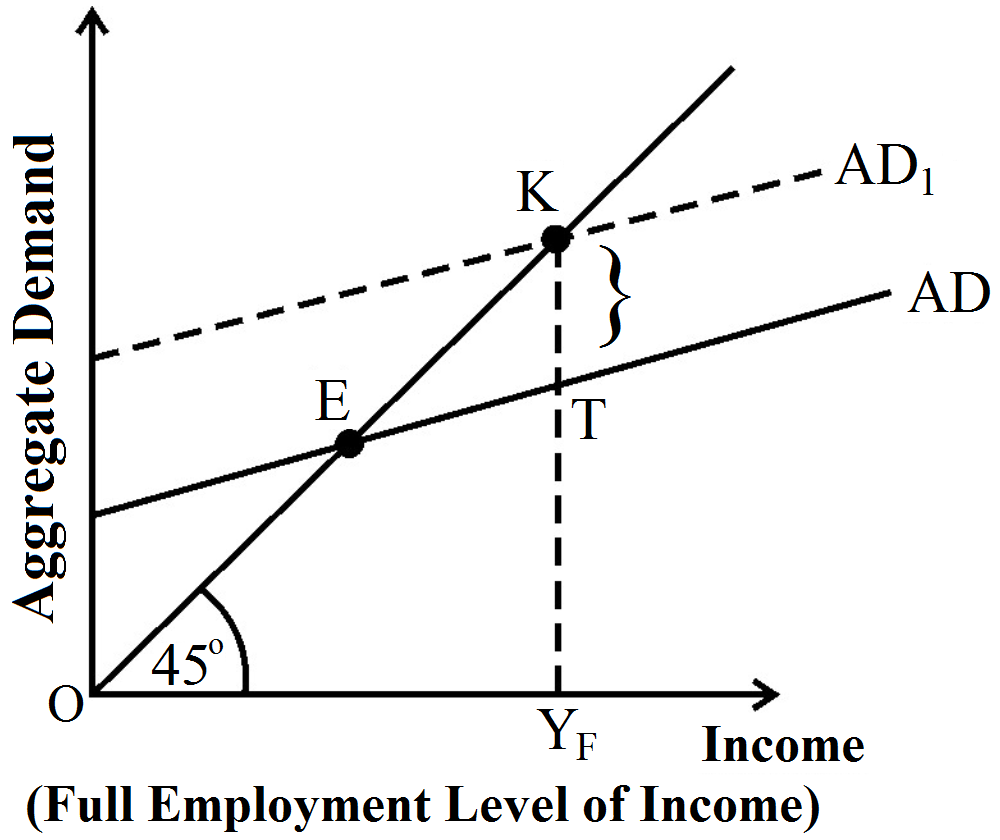
In the given figure, what does the gap ‘KT’ represent? State any two fiscal measures to correct the situation.

Define full employment in an economy. Discuss the situation when aggregate demand is more than aggregate supply at full employment income level.
Under perfect competition, firms can sell any quantity at the existing price, then why firms are reluctant to reduce the price in order to capture the entire market?