Question
  1. Distinguish between ionic and covalent compounds under the following properties:
  1. Strength of forces between constituent elements’.
  2. Solubility of compounds in water.
  3. Electrical conduction in substances.

Answer

  1.  
  1.  
Property
Ionic Compounds
Covalent Compounds
Strength of forces
Strong
Weak
Solubility
Generally soluble in water
Generally insoluble in water/ soluble in organic solvents.
Electrical Conductivity
Conduct electricity
Do not conduct electricity

Need a full question paper?

Generate a complete, print-ready paper with questions like this in minutes — across 16+ boards, with answer keys.
Start Generating Free

Similar questions


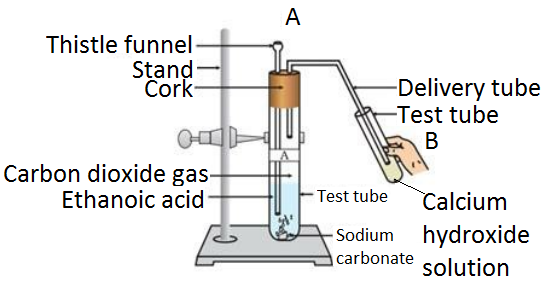
Look at Figure and answer the following questions:
  1. What change would you observe in the calcium hydroxide solution taken in tube B?
  2. Write the reaction involved in test tubes A and B respectively.
  3. If ethanol is given instead of ethanoic acid, would you expect the same change?
  4. How can a solution of lime water be prepared in the laboratory?
At what distance from a concave lens of focal length 20 cm a 6 cm tall object be placed so as to obtain its image at 15 cm from the lens? Also, calculate the size of the image formed.
Draw a ray diagram to justify your answer for the above situation and label it.
What is meant by ‘rusting of iron’? With the help of labelled diagrams, describe an activity to find out the conditions under which iron rusts.
The farmers have been cultivating a food plant X for over two thousand years and have produced as many as five entirely different looking vegetables A, B, C, D and E from it.
  1. What could the plant X be?
  2. What are A, B, C, D and E?
  3. What is the process of evolution involved in this example known as?
A, B and C are three living organisms. The organism A is a unicellullar fungus which can live without air. It is used in the commercial production of an organic compound P from molasses. The organism B is a unicellular animal which lives in water and feeds and moves by using pseudopodia. It breathes through an organelle Q. The organism C is a tiny animal which acts as a carrier of malarial parasite. It breathes and respires through a kind of tiny holes R and air - tubes S in its body.
  1. What are organisms A, B and C?
  2. Name P, Q, R and S.
  3. Which organism/ organisms undergo aerobic respiration?
  4. Which organism/ organisms undergo anaerobic respiration?
The sea water contains water beetles, tadpole, fish and weeds.
  1. Write a food chain comprising all the given organisms?
  2. Which organisms in the food chain are (i) herbivore, and (ii) carnivores?
  3. Which organisms are (i) predators, and (ii) prey?
  4. Which organisms can trap solar energy to make food?
  5. Which organism is a secondary consumer?
A metal which exists as a liquid at room temperature is obtained by heating its sulphide ore in the presence of air.
  1. Name the metal and write its chemical symbol.
  2. Write the name and formula of the sulphide ore.
  3. Give the equations of chemical reactions involved in the production of metal from its sulphide ore.
  4. Name a common device in which this metal is used.
  5. Can this metal displace copper from copper sulphate solution? Why?
Trace the path of sperm during ejaculation and mention the gland and their functions associated with the male reproductive system.
List the sign conventions that are followed in case of refraction of light through spherical lenses. Draw a diagram and apply these conventions in determining the nature and focal length of a spherical lens which forms three times magnified real image of an object placed 16cm from the lens.
Explain the following in terms of gain or loss of oxygen with two examples each.
  1. Oxidation
  2. Reduction