Question
Distinguish between longitudinal and transverse waves.

Answer

Longitudinal wave: A wave in which the particles of the medium vibrate back and forth in the ‘same direction’, in which the wave is moving, is called a longitudinal wave. These waves can be produced in all the three media: solids, liquids and gases. Transverse wave: A wave in which the particles of the medium vibrate up and down, ‘at right angles’ to the direction in which the wave is moving, is called a transverse wave. It can be produced in solids and liquids but not in gases.
Need a full question paper?

Generate a complete, print-ready paper with questions like this in minutes — across 16+ boards, with answer keys.

Start Generating Free

Similar questions

Describe an experiment to show that sound cannot pass through vacuum.
Write down four characters of Osteichthyes and give two examples.
i. Describe the role played by the lysosomes. Why are they termed as suicidal bags? How do they perform their function?
ii. What happens to the dry raisins, when placed in plain water for some time? State the reason for whatever is observed. What would happen if these raisins are then placed in concentrated salt solution?
What is epithelial tissue? Give its characteristics and functions.
State Newton’s third law of motion and give two examples to illustrate the law.
An automobile engine propels a $1000kg$ car $(A)$ along a levelled road at a speed of $36km h^{-1}$. Find the power if the opposing frictional force is $100N$. Now, suppose after travelling a distance of $200m$, this car collides with another stationary car $(B)$ of same mass and comes to rest. Let its engine also stop at the same time. Now car $(B)$ starts moving on the same level road without getting its engine started. Find the speed of the car $(B)$ just after the collision.
By which physical process the fragrance of burning an incense stick spreads all around?
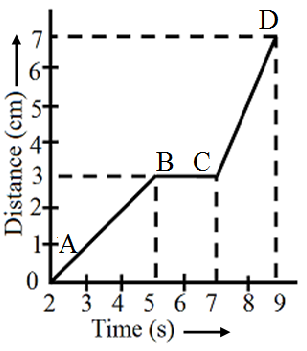
The graph given alogside shows the positions of a body at different times. Calculate the speed of the body as it moves from:
  1. $A$ to $B.$
  2. $B$ to $C.$
  3. $C$ to $D.$
Describe the various steps involved in the purification of water for city water supply.
Distinguish between fertilizer and manure. Give suitable examples. What are advantages and disadvantages of using fertilizer?