Question
  1. Distinguish between parasitism and predation, with an example of each.
  2. Name two groups of animals, that are regulaters.
  3. When does the growth curve assume of J shape?

Answer

  1.  
  Parasitism   Predation
1 It is the interspecific interaction, where one species (called parasite) takes food and shelter from another living organisms (host) and damage the lost in due course of time. 1 It is the interspecific interaction in which a larger animal (predator) kills and consumes a smaller animal (prey) as food.
2 The organism harmed is larger. 2 The animal harmed is smaller.
3 Parasite does not kill and consume the host. 3 Predator kills and consumes the host.
  1. Birds and mammals.
  2. The growth curve assumes J shape, when the resources are not limiting.

Need a full question paper?

Generate a complete, print-ready paper with questions like this in minutes — across 16+ boards, with answer keys.

Start Generating Free

Similar questions

Compare the life style of people living in the urban areas with those of rural areas and briefly describe how the life style affects their health.
Try to trace the various components of human evolution (hint: brain size and function, skeletal structure, dietary preference, etc.)
Arun visited his grandfather's farm and noticed that one of the workers was introducing earthworms in the soil. He quickly rushed to his grandfather and asked him the reason. His grandfather explained him the advantages of earthworm in soil improvement.
  1. Why are earthworms also known as detritivores?
  2. Explain fragmentation.
  3. Name the steps in the process of decomposition.
  4. What values are shown by Arun?
One chromosome contains one molecule of DNA. In eukaryotes the length of the DNA molecule is enormously large. Explain how such a long molecule fits into the tiny chromosomes seen at metaphase.
Name and describe the steps involved in the technique widely used in forensics that serves as the basis of paternity testing in case of disputes.
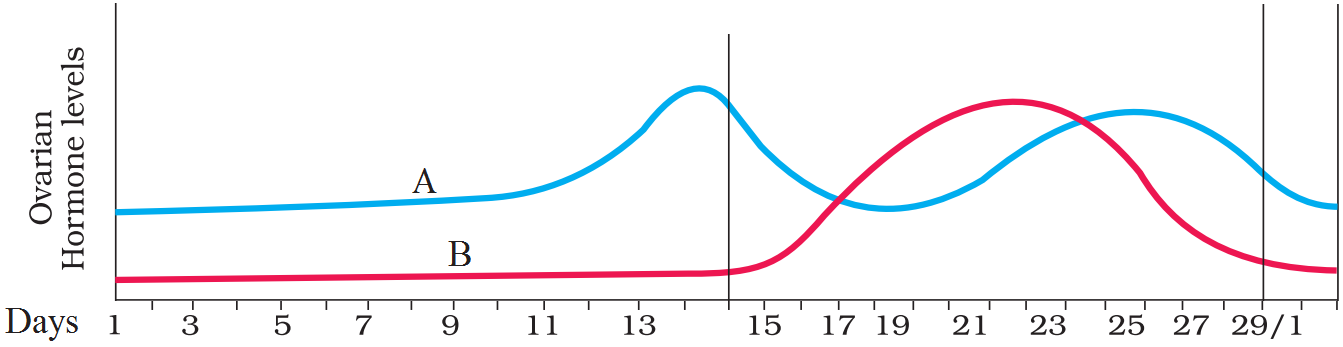
The graph given below shows the variation in the levels of ovarian hormones during various phases of menstrual cycle:

Specify the source of the hormone marked in the diagram.

Human female is not fertile after menopause whereas males can produce gametes at any age after puberty. Analyse the statement and schematically represent a comparison between gametogenesis in males and females.
The following is the illustration of the sequence of ovarian events (a-i) in a human female.

Name the ovarian hormone and the pituitary hormone that have caused the above mentioned event.

Sakshi's father announced that the children are going to spend this weekend with their grandparents. During the journey, Sakshi saw some farmers who were spraying agrochemicals in their field. She requested her father to stop them. Her father praised her and contacted the farmers. He explained the side effects of such agrochemicals. He also suggested them to use biopesticides and biofertilisers instead of such chemicals. The farmers gave up spraying agrochemicals.
  1. What did Sakshi's father explain to the farmers?
  2. What are agrochemicals?
  3. Why are biofertilisers or biopesticides preferred to chemical fertilisers or pesticides?
  4. What values did Sakshi promote?
Describe the beneficial activities of bacteria. ###How can we say that bacteria are our friends? Explain.