Question
Distinguish between shares and debentures $[$Three points$].$

Answer

Shares Debentures
$(1)$ Share is owner's capital. Shareholder is the owner of the company. $(1)$ Debenture is borrowed capital. Debenture holder is creditor of the Company.
$(2)$ Shares cannot be issued at discount. $(2)$ Debentures can be issued at discount.
$(3)$ If the company cannot earn a profit, Dividend may not be paid to shareholders. Thus, return on share capital is not certain. $(3)$ Company has to pay interest on debentures at the rate specified in the agreement.
$(4)$ As the share is owner's capital, there is no need to mortgage the company's assets. $(4)$ As the debenture is the borrowed capital, the company creates the fixed or floating mortgage on its assets.
$(5)$ Shareholders have right to participate and to vote in the management of the company. $(5)$ Debenture holders do not have any right to participate or to vote in the management of the company.
$(6)$ A company cannot issue shares which are convertible into debentures. $(6)$ A company can issue such debentures which can be converted into shares.

Need a full question paper?

Generate a complete, print-ready paper with questions like this in minutes — across 16+ boards, with answer keys.
Start Generating Free

Similar questions

Where will you disclose the effects of the following adjustments during the preparation of final accounts of a partnership firm : Unrecorded credit sales
In which circumstances court can pass the order for dissolution of a firm? Explain.
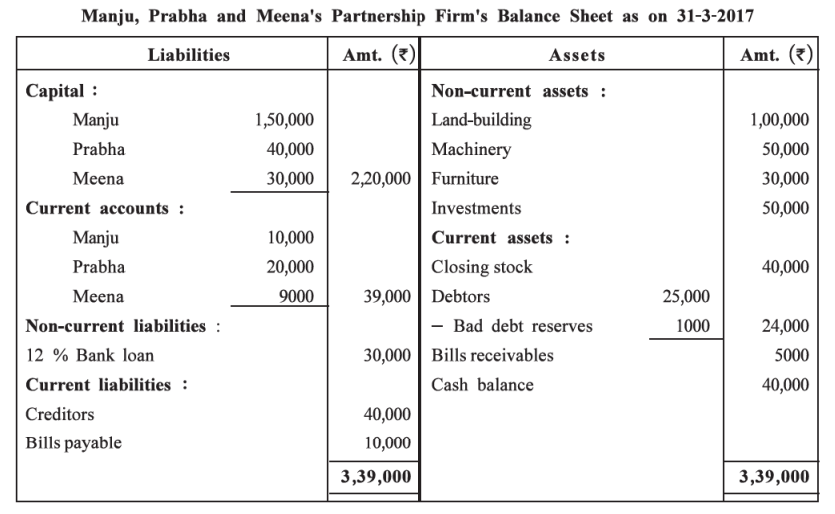
Manju, Prabha and Meena are the partners of a partnership firm. Their profit-loss sharing ratio is $5: 3: 2 .$ They want to change their profit-loss sharing ratio to $3: 2: 1 .$ Therefore, they decided to revalue the assets-liabilities of the firm. From the following information prepare revaluation account and balance sheet after revaluation.Additional information:
$(1)$ The value of land-building is to be increased by $25 \%.$
$(2)$ The value of furniture is to be reduced by $10 \%.$
$(3)$ The value of machinery is to be kept $80 \%.$
$(4)$ The book value of closing stock is $5000$ more than its market value.
$(5)$ Total amount of $2500$ is to be kept for bad debts reserve on debtors.
$(6)$ An amount of $2 3000$ among the creditors is now not to be paid.
$(7)$ Interest on bank loan for last three month is outstanding.
Pass journal entries for the following of firm in the case of firm's dissolution:
$1.$ The value of laptop is $Rs. 35,000.$ One partner has taken it for $Rs. 25,000.$
$2.$ A partner has accepted to pay loan of his Smt. $Rs. 40,000,$ which was given to the firm.
$3.$ Goodwill is not disclosed in the book. But $Rs. 50,000$ are realised during dissolution.
HIJ Limited issued equity shares of $₹ 10$ each. Amount called up on application $₹ 2.50$ per share, on allotment $₹ 3$ per share, on first call $₹ 3$ per share and on final call $₹ 1.50$ per share. A shareholder, Dhaval had $600$ shares. He did not pay allotment money and first call money and hence his shares were forfeited before making final call. Pass the journal entry in the books of company for forfeiture of shares.
Illustration $11 :$ Aayush and Aaditya are the partners sharing profit and loss in the ratio of $5:3.$ They admitted Parth as a new partner in the firm :or $\frac{1}{4}$ th share. Parth brings land and building worth $₹ 1,00,000$, motor car $₹ 50,000$ and cash $₹ 30,000$ for his capital and premium for goodwill. Goodwill of the firm is valued $₹ 1,60,000$. The new profit and loss ratio is decided at $2: 1: 1$. Give necessary journal entry.
Explain three objectives of ratio analysis.
Total assets are $₹ 1,50,000$ of firm $A$ and $B$ where cash of $₹ 10,000$ is included. Net assts of the firm are $₹ 1,00,000.$ The ratio of capital and reserve is $4 : 1.$ The capital of $A$ is more than of B by $₹ 20,000.$ Loss of realisation account is $₹ 20,000.$ Firm is dissolved. Prepare realisation account.
Total Assets of firm at the time of dissolution is $₹ 2,00,000.$ Out of which $40\%$ are current assets $($including cash f $10,000).\ 120\%$ realised for fixed assets. While $80\%$ are realised of current asset. Pass journal entries.
Explain the functional classification of ratios.