Question
Distinguish between the following. Xylem and Phloem.

Answer

S. No.
Xylem
Phloem
$(i)$
It transports water from roots to different parts of plant.
It transports food from the leaves to different parts of plant.
$(ii)$
The movement of water is unidirectional.
The movement of food is bidirectional.
$(iii)$
It is a living tissue.
It is non-living at maturity.

Need a full question paper?

Generate a complete, print-ready paper with questions like this in minutes — across 16+ boards, with answer keys.
Start Generating Free

Similar questions

How do the plants like sugarcane, potato and rose reproduce when they cannot produce seeds?
The smallest time interval that can be measured with commonly available clocks and watches is one second. However, special clocks are available that can measure time intervals smaller than a second. Some of these can measure time intervals as small as one millionth or even one billionth of a second.
1. A micro-second is a very small time interval. Write its value in fraction of a second.
2. Define time period.
3. What is the basic unit of time?
Make a table to show the donor blood group and recipient blood group.
Suggest two methods to find out wind direction at a given place.
What is sewage? Explain why it is harmful to discharge untreated sewage into rivers or seas?
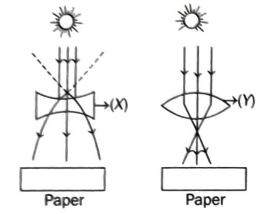
A student is asked to focus sunlight using two different lenses onto a paper.
Image

Observe the image carefully and answer the following questions.
(i) State the name for the shape of lenses X and Y.
(ii) Which of these two lenses can be used to magnify images?
(iii) Explain the changes that happen to the paper kept under both the lenses.
What is sewage? Explain why it is harmful to discharge untreated sewage into rivers or seas.
Deforestation can be considered as a reason for depletion of the water table. Comment.
Read the passage and answer the questions :
A student is conducting an experiment to observe the reaction of magnesium ribbon when it is burned in air. The student first cleans a small piece of magnesium ribbon using sandpaper and then ignites it using a flame. The ribbon burns with a dazzling white flame, and a white powdery substance is formed after the reaction. The student records these observations and continues to investigate the nature of the product formed by adding a small amount of water to the white powder.
Q.1. What is the white powder formed after burning magnesium ribbon?
(a) Magnesium sulphate
(b) Magnesium oxide
(c) Magnesium hydroxide
(d) Magnesium carbonate
Q.2. Which of the following will most likely happen after magnesium ribbon burns?
(a) The product will turn blue litmus paper red
(b) The product will turn red litmus paper blue
(c) The product will have no effect on litmus paper
(d) The product will blue litmus paper red as well as red litmus paper blue
Q.3. What is the result of adding water to magnesium oxide?
(a) It forms an acidic solution
(b) It forms a basic solution
(c) It forms a neutral solution
(d) It does not react with water
Explain how the exchange of gases occurs in human beings.