Question
Distinguish between the following
Nucleus and Nucleolus

Answer

NucleusNucleolus
Large in sizeVery small in size
Bound by the nuclear envelopeIt has no limiting membrane
It contains chromosomes.It does not hold any chromosomes
It is rich in DNA, the genetic materialIt is rich in RNA

Need a full question paper?

Generate a complete, print-ready paper with questions like this in minutes — across 16+ boards, with answer keys.
Start Generating Free

Similar questions

Draw and describe the structure of a neuron.
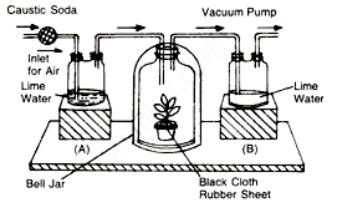
Given alongside is an experimental set up to demonstrate a phenomenon in a plant:
(a) What is the aim of this experiment?
(b) Why was the bell jar covered with a black cloth?
(c) What is the function of caustic soda in this experiment?
(d) Give an overall chemical equation of the process mentioned in (a) above. (e) Mention one precaution that should be taken to ensure more accurate results.
What change, if any, would you observe in the lime water in Flask A and B? In each case give a reason for your answer.
Image
How is the liver an important organ in our body?
What is digestion? Why do only animals require a digestive system?
Match the items in Column A with those in Column B.

Column A

Column B

(a) Generative nucleus

(i) Pollen tube

(b) Germ pore

(ii) Endosperm nucleus

(c)Exine

(iii)Testa

(d) Secondary nucleus

(iv) Fertilization

(e) Integument

(v) Male nuclei

(f) Egg nucleus

(vi) Rough

Distinguish between the following pairs:
Petals and petaloid sepals
Write various advantages of vegetative propagation.
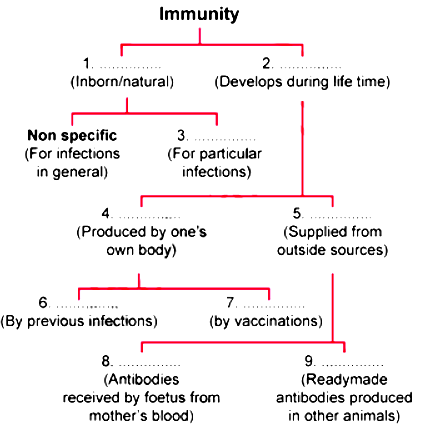
Given below is a scheme of classifying immunity against human diseases. Fill up the types of immunity in the blanks 1-9.
Match items in Column A with the appropriate items in Column B:
Column AColumn B
RustBacterial disease
TyphoidNitrobacter
CoenocyticPenicillin
AspergillosisCrop disease
SymbioticRhizopus
SporangiophoreStudy of fungi
MycologySporangia
Nitrifying bacteriaRhizobium
AntibioticFungal disease
What do you understand by infectious disease? Discuss any one disease.