Magnetic Fields due to Electric Current — Physics STD 12 Science — Question
Maharashtra BoardEnglish MediumSTD 12 SciencePhysicsMagnetic Fields due to Electric Current4 Marks
Question
Distinguish between the forces experienced by a moving charge in a uniform electric field and in a uniform magnetic field.
✓
Answer
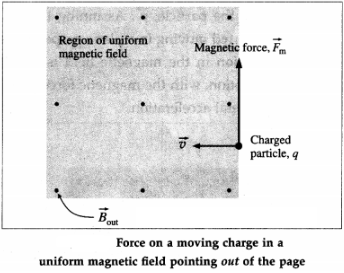
A charge q moving with a velocity $\vec{v}$ through a magnetic field of induction $\vec{B}$ experiences a magnetic force perpendicular both to $\vec{B}$ and $\vec{v}$. Experimental observations show that the magnitude of the force is proportional to the magnitude of $\vec{B}$, the speed of the particle, the charge $q$ and the sine of the angle $\theta$ between $\vec{v}$ and $\vec{B}$. That is, the magnetic force, $\mathrm{F}_{\mathrm{m}}=q v B \sin \theta$ $\therefore \vec{F}_{\mathrm{m}}=q(\vec{v} \times \vec{B})$
Therefore, at every instant $\vec{F}_{\mathrm{m}}$ acts in a direction perpendicular to the plane of $\vec{v}$ and $\vec{B}$
If the moving charge is negative, the direction of the force $\vec{F}_{\mathrm{m}}$ acting on it is opposite to that given by the right-handed screw rule for the cross-product $\vec{v} \times \vec{B}$
If the charged particle moves through a region of space where both electric and magnetic fields are present, both fields exert forces on the particle. The force due to the electric field $\vec{E}$ is $\vec{F}_{\mathrm{e}}=q \vec{E}$.
The total force on a moving charge in electric and magnetic fields is called the Lorentz force :
$
\vec{F}=\vec{F}_{\mathrm{e}}+\vec{F}_{\mathrm{m}}=q(\vec{E}+\vec{v} \times \vec{B})
$
Special cases :
(i) $\vec{v}$ is parallel or antiparallel to $\vec{B}$ : In this case, $\mathrm{F}_{\mathrm{m}}=\mathrm{qvB} \sin 0^{\circ}=0$. That is, the magnetic force on the charge is zero.
(ii) The charge is stationary $\{v=0)$ : In this case, even if $q \neq 0$ and $B \neq 0, F_m=$ $q(0) B \sin \theta=0$. That is, the magnetic force on a stationary charge is zero.
Need a full question paper?
Generate a complete, print-ready paper with questions like this in minutes — across 16+ boards, with answer keys.