Question
Distinguish clearly between the three modes of heat transmission.

Answer

Three modes of heat transmission are conduction, convection and radiation. Their main points of distinction are as follows:
S. No
Conduction
Convection
Radiation
1.
There is no bodily motion of medium particles. Medium particles vibrate to and fro about their mean positions and pass on thermal energy to the neighbouring particles.
Heat is transferred from one part of system to another by the actual motion of the particles of the system.
Medium has no role as thermal radiation are transmitted without any material medium.
2.
No convection currents are formed.
Convection currents are formed.
Question of formation of convection currents does not arise.
3.
Conduction of heat takes place in solids and few liquids like mercury and molten metals.
Convection of heat takes place in fluids i.e., liquids as well as gases.
Radiant energy directly flows from heat source to the given body at a speed of 3 × 10m8/ s as electromagnetic waves.

Need a full question paper?

Generate a complete, print-ready paper with questions like this in minutes — across 16+ boards, with answer keys.
Start Generating Free

Similar questions

A person in an elevator accelerating upwards with an acceleration of 2m s–2, tosses a coin vertically upwards with a speed of 20m s1. After how much time will the coin fall back into his hand? (g = 10m s–2)
  1. What can be the maximum and minimum values of $(\vec{\text{A}}+\vec{\text{B}})$ and $(\vec{\text{A}}-\vec{\text{B}})?$
  2. If two vectors of equal magnitude added to each other gives magnitude of one of them. What is the angle between them?
An electric fan of mass 2kg falls from the ceiling of a lift moving down with uniform speed of 2ms-1. It hits the floor of the lift (length of the lift = 2m) and does not rebound. How much heat will be produced by the impact?
Two thermometers are constructed in the same way except that one has a spherical bulb and the other has an elongated cylindrical bulb. Which one will respond quickly to the temperature changes? Why?
What is the period of revolution of Neptune around the sun, given that the diameter of its orbit is 30 times the diameter of the earth's orbit around the sun, both orbits being assumed to be circular? Taking the moon's orbit around earth to be r and mass of earth 81 times the mass of the moon, find the position of the point from the earth where the net gravitational field is zero.
Show that the particle performs harmonic motion in a parabolic potential well.
A man walks on a straight road from his home to a market 2.5km away with a speed of 5km h–1. Finding the market closed, he instantly turns and walks back home with a speed of 7.5km h–1. What is the
Average speed of the man over the interval of time
  1. 0 to 30 min,
  2. 0 to 50 min,
  3. 0 to 40 min?
[Note: You will appreciate from this exercise why it is better to define average speed as total path length divided by time, and not as magnitude of average velocity. You would not like to tell the tired man on his return home that his average speed was zero!]
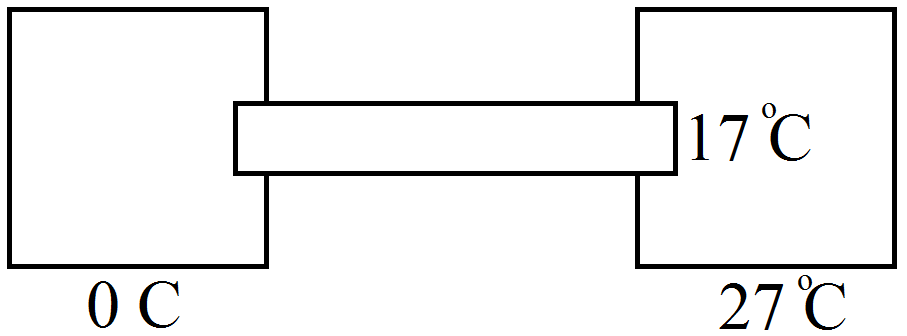
A cylindrical rod of length 50cm and cross sectional area 1cm2 is fitted between a large ice chamber at 0°C and an evacuated chamber maintained at 27°C as shown in figure. Only small portions of the rod are inside the chambers and the rest is thermally insulated from the surrounding. The cross section going into the evacuated chamber is blackened so that it completely absorbs any radiation falling on it. The temperature of the blackened end is 17°C when steady state is reached. Stefan constant $\sigma=6\times10^{-8}\text{W/m}^{-2}\text{K}^{-4}.$ Find the thermal conductivity of the material of the rod.

Compute the fractional change in volume of a glass slab, when subjected to a hydraulic pressure of 10 atm.
One end of a string of length l is connected to a particle of mass m and the other to a small peg on a smooth horizontal table. If the particle moves in a circle with speed v the net force on the particle (directed towards the centre) is:
  1. $\text{T}.$
  2. $\text{T}-\frac{\text{m}\nu^2}{\text{l}}$
  3. $\text{T}+\frac{\text{m}\nu^2}{\text{l}}$
  4. $0$
T is the tension in the string. [Choose the correct alternative].