MCQ
$\frac{\sec 49^{\circ}}{\operatorname{cosec} 41^{\circ}}=$ ?
  • $1$
  • B
    $0$
  • C
    $\frac{3}{4}$
  • D
    None of these

Answer

Correct option: A.
$1$
$\frac{\sec 49^{\circ}}{\operatorname{cosec} 41^{\circ}}=\frac{\sec \left(90^{\circ}-41^{\circ}\right)}{\operatorname{cosec} 41^{\circ}}$
$=\frac{\operatorname{cosec} 41^{\circ}}{\operatorname{cosec} 41^{\circ}} (\because \sec (90-\theta)=\operatorname{cosec} \theta)$
$=1$

Need a full question paper?

Generate a complete, print-ready paper with questions like this in minutes — across 16+ boards, with answer keys.

Start Generating Free

Similar questions

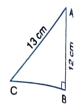
In Fig. $\tan A-\cot C$ is equal to
Image
$\triangle \text{ABC}\sim\triangle\text{DEF}, \text{ar}(\triangle\text{ABC})=9\text{ cm}^2,\ \text{ar} (\triangle\text{DEF})=16\text{ cm}^2.$ If $BC = 2.1\ cm,$ then the measure of $EF$ is :
The $5^{\text {th }}$ term of an $AP$ is $20$ and the sum of its $7^{\text {th }}$ and $11^{\text {th }}$ terms is $64$ . The common difference of the $Ap$ is:
The radius of a circle is 20cm. It is divided into four parts of equal area by drawing three concentric circles inside it. Then, the radius of the largest of three concentric circles drawn is:
In $\triangle\text{ABC}\sim\triangle\text{DEF}$ and the perimeters of $\triangle\text{ABC}$ and $\triangle\text{DEF}$ are $30\ cm$ and $18\ cm$  respectively. If $BC = 9\ cm$ then $EF =?$
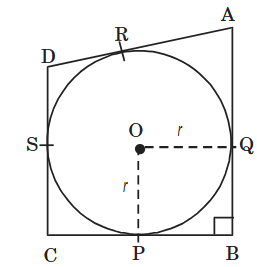
In Fig. $2,$ a circle with centre $O$ is inseribed in a quadrilateral $\text{ABCD}$ such that, it touches the sides $B C, A B, A D$ and $C D$ at points $P, Q, R$ and $S$ respectively, If $A B=29 \ cm, A D=23 \ cm, \angle B=90^{\circ}$ and $D S=5 \ cm$, then the radius of the circle $($in $\ cm )$ is:
Image
Choose the correct answer from the given four options.
The value of $(\tan1^\circ\tan2^\circ\tan3^\circ...\tan89^\circ)$ is:
Which of the following is a true statement?
If $\alpha$ and $\beta$ are the zeroes of the polynomial $p(x)= kx ^2-30 x +45 k$ and $\alpha+\beta=\alpha \beta$, then the value of k is :
The chord of a circle of radius $10\ cm$ subtends a right angle at its centre. The length of the chord $($in $cm)$ is :