Question
Do magnetic forces obey Newton's third law. Verify for two current elements $\text{dI}_1=\text{dI}\hat{\text{i}}$ located at the origin and $\text{dI}_2=\text{dI}\hat{\text{j}}$ located at (0, R, 0). Both carry current I.

Answer

Key concept: In this problem first we have to find the direction of magnetic field due to one wire at the point on other wire, then the magnetic force on that current carrying wire.
According to Biot-Savart's law, magnetic field B is parallel to idl × r and idl is the current carrying element having it's direction along the direction of flow of current.
Here, for the direction of magnetic field, at dl2, located at (0, R, 0) due to wire dlx is given by B || idl × r or i × j (because point (0, R, 0) lies ony-axis), but i × j = k.
So, the direction of magnetic field at dl2 is along z-direction.
The direction of magnetic force exerted at dl2 due to the magnetic field of first wire is along the x-axis.
F - i(l × B), i.e., F || (i × k) or along -j direction.
Therefore, force due to dl [on dl2 is non-zero.]
Now, for the direction of magnetic field, at dx, located at (0, 0, 0) due to wire d2 is given by B || idl × r or j × -j (because origin lies on y-direction w.r.t. point (0, R, 0), but j × -j = 0.
So, the magnetic field at dx does not exist.
Force due to dl2 on dl1, is zero.
So, magnetic forces do not obey Newton's third law. But they obey Newton's third law if current carrying element are placed parallel to each other.
Need a full question paper?

Generate a complete, print-ready paper with questions like this in minutes — across 16+ boards, with answer keys.

Start Generating Free

Similar questions

A 12.5 eV electron beam is used to bombard gaseous hydrogen at room temperature. What series of wavelengths will be emitted? 
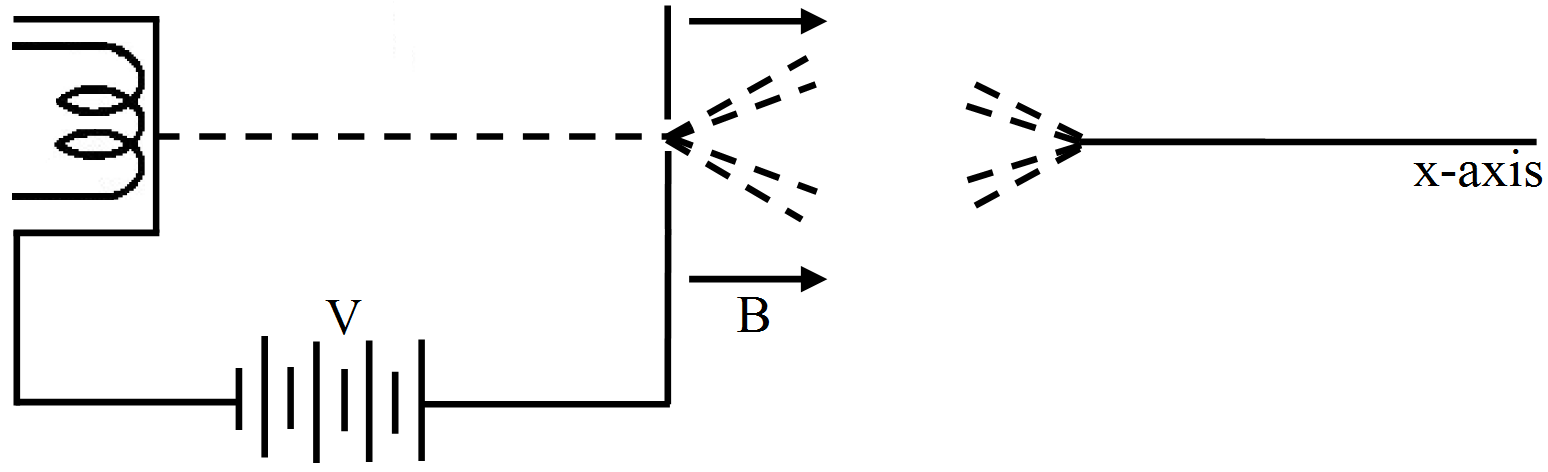
Electrons emitted with negligible speed from an electron gun are accelerated through a potential difference V along the x-axis. These electrons emerge from a narrow hole into a uniform magnetic field B directed along this axis. However, some of the electrons emerging from the hole make slightly divergent angles, as shown in the figure. Show that these paraxial electrons are refocussed on the x-axis at a distance $\sqrt{\frac{8\pi^2\text{mV}}{\text{eB}^2}}.$

A charged particle oscillates about its mean equilibrium position with a frequency of 109 Hz. What is the frequency of the electromagnetic waves produced by the oscillator?
Four particles having masses m, 2m, 3m and 4m are placed at the four corners of a square of edge a. Find the gravitational force acting on a particle of mass m placed at the centre.
A gun is mounted on a railroad car. The mass of the car, the gun, the shells and the operator is 50m where m is the mass of one shell. If the velocity of the shell with respect to the gun (in its state before firing) is 200m/s, what is the recoil speed of the car after the second shot? Neglect friction.
In a CE transistor amplifier there is a current and voltage gain associated with the circuit. In other words there is a power gain. Considering power a measure of energy, does the circuit voilate conservation of energy?
An electric field is uniform, and in the positive $x$ direction for positive $x$, and uniform with the same magnitude but in the negative $x$ direction for negative $x$. It is given that $E =200 \hat{ i } N / C$ for $x>0$ and $E =-200 \hat{ i } N / C$ for $x<0$. A right circular cylinder of length $20 cm$ and radius $5 cm$ has its centre at the origin and its axis along the $x$-axis so that one face is at $x=+10 cm$ and the other is at $x=-10 cm$ (Fig. 1.25). (a) What is the net outward flux through each flat face? (b) What is the flux through the side of the cylinder? (c) What is the net outward flux through the cylinder? (d) What is the net charge inside the cylinder?
A train starts from rest and moves with a constant acceleration of 2.0m/s2 for half a minute. The brakes are then applied and the train comes to rest in one minute. Find:
  1. The total distance moved by the train.
  2. The maximum speed attained by the train.
  3. The position(s) of the train at half the maximum speed.
A neutron moving with a speed υ strikes a hydrogen atom in ground state moving towards it with the same speed. Find the minimum speed of the neutron for which inelastic (completely or partially) collision may take place. The mass of neutron = mass of hydrogen = 1.67 × 10⁻²⁷kg.
Define electric potential difference and prove that the electric potential at any point inside the electric field is equal to the ratio of the work W done in bringing a test charge from infinity to that point and the value of the test charge $q_0$.