Question
Do permeability and relative permeability have the same dimensions?

Answer

Magnetic permeability $(\mu)$ is the ratio of magnatic flux density (B) to the megnatising field strength (H).

$\mu=\frac{\text{B}}{\text{H}}$

In CGS (centimeter-gram-second) dimension of B and H is same. Hence, magnetic permeability is dimensionless. But in SI unit, dimension of B and H is not same. Thus, permeability is not dimensionless.

Relative ​permeability is defined as the ratio of magnetic permeability of any medium to the permeability of the vaccum. Hence, it is dimensionless. Thus, permeability and relative permeability have the same dimensions in CS system.

Need a full question paper?

Generate a complete, print-ready paper with questions like this in minutes — across 16+ boards, with answer keys.
Start Generating Free

Similar questions

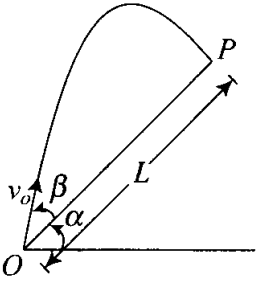
A particle is projected in air at an angle $\beta$ to a surface which itself is inclined at an angle $\alpha$ to the horizontal (Fig.).

  1. β at which range will be maximum.
(Hint: This problem can be solved in two different ways:

  1. Point P at which particle hits the plane can be seen as intersection of its trajectory (parobola) and straight line. Remember particle is projected at an angle $(\alpha+\beta)$ w.r.t. horizontal.
  2. We can take x-direction along the plane and y-direction perpendicular to the plane. In that case resolve g (acceleration due to gravity) in two differrent components, gx along the plane and gy perpendicular to the plane. Now the problem can be solved as two independent motions in x and y directions respectively with time as a common parameter.)
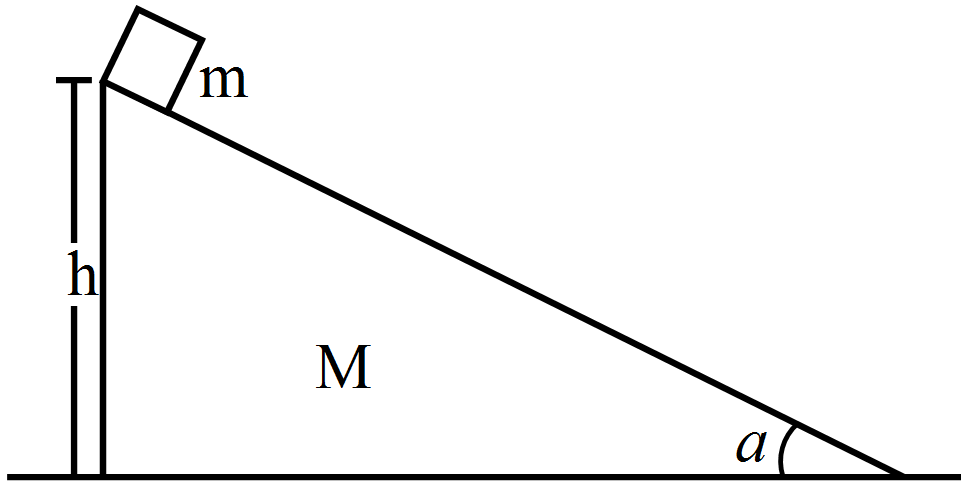
A block of mass m is placed on a triangular block of mass M, which in turn is placed on a horizontal surface as shown in figure. Assuming frictionless surfaces find the velocity of the triangular block when the smaller block reaches the bottom end.

Describe surface tension on the basis of molecular forces.
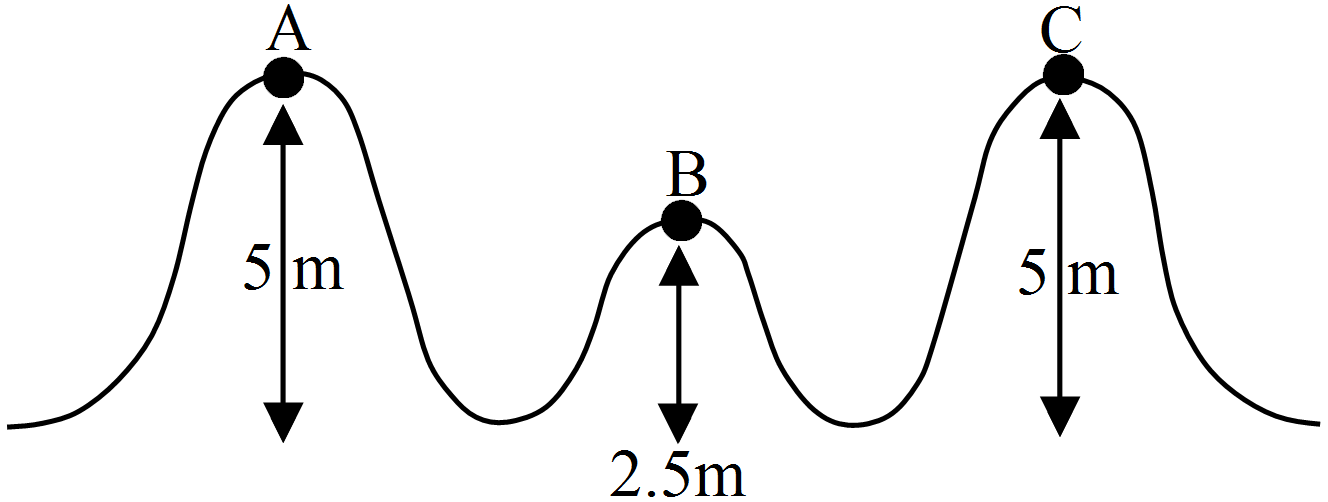
A mass 5kg starts sliding from A on a smooth surface shown in the figure. Find the velocity of the mass at B and C?

State, for each of the following physical quantities, if it is a scalar or a vector : volume, mass, speed, acceleration, density, number of moles, velocity, angular frequency, displacement, angular velocity.
The displacement of an elastic wave is given by the function $\text{y}=3\sin\omega\text{t}+4\cos\omega\text{t}$ where y is in cm and t is in second. Calculate the resultant amplitude.
An artificial satellite is revolving around a planet of mass M and radius R, in a circular orbit of radius r. From Kepler’s Third law about the period of a satellite around a common central body, square of the period of revolution T is proportional to the cube of the radius of the orbit r. Show using dimensional analysis, that $\text{T}=\frac{\text{k}}{\text{R}}\sqrt{\frac{\text{r}^3}{\text{g}}},$ where k is a dimensionless constant and g is acceleration due to gravity.
Show that in case of one dimensional elastic collision of two bodies, the relative velocity of separation after the collision is equal to the relative velocity of approach before the collision.
Explain isothermal, isobaric and adiabatic processes and write equations of state for them.
A transverse harmonic wave on a string is described by
$\text{y}(\text{x, t})=3.0\sin\big(36\text{t}+0.018\text{x}+\frac{\pi}{4}\big)$
where x and y are in cm and t in s. The positive direction of x is from left to right.
Is this a travelling wave or a stationary wave?
If it is travelling, what are the speed and direction of its propagation?