Question
Do permeability and relative permeability have the same dimensions?

Answer

Magnetic permeability $(\mu)$ is the ratio of magnatic flux density (B) to the megnatising field strength (H).
$\mu=\frac{\text{B}}{\text{H}}$
In CGS (centimeter-gram-second) dimension of B and H is same. Hence, magnetic permeability is dimensionless. But in SI unit, dimension of B and H is not same. Thus, permeability is not dimensionless.
Relative ​permeability is defined as the ratio of magnetic permeability of any medium to the permeability of the vaccum. Hence, it is dimensionless. Thus, permeability and relative permeability have the same dimensions in CS system.

Need a full question paper?

Generate a complete, print-ready paper with questions like this in minutes — across 16+ boards, with answer keys.
Start Generating Free

Similar questions

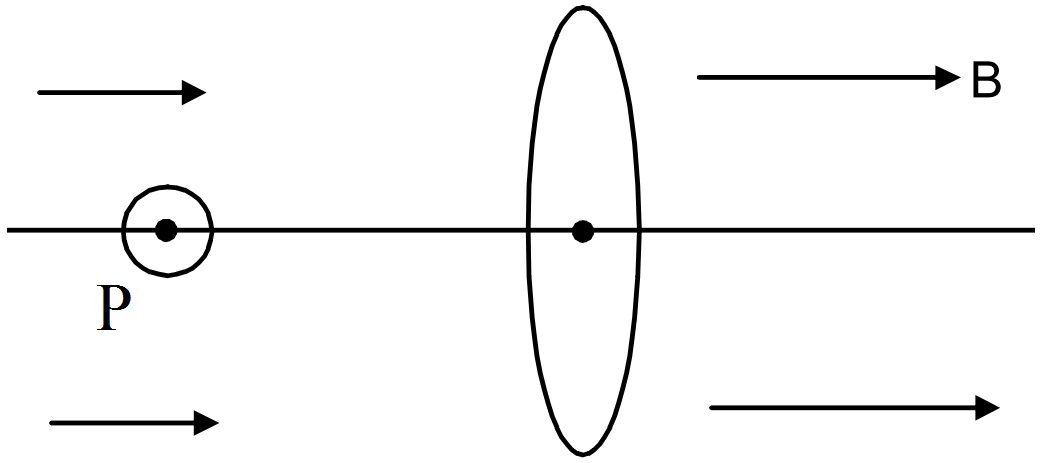
Shows a convex lens of focal length 12cm lying in a uniform magnetic field B of magnitude 1.2T parallel to its principal axis. A particle with charge $2.0 \times 10^{-3}$C and mass $2.0 \times 10^{-5}$ kg is projected perpendicular to the plane of the diagram with a speed of $4.8 ms^{-1}$. The particle moves along a circle with its centre on the principal axis at a distance of 18cm from the lens. Show that the image of the particle moves along a circle and find the radius of that circle.
A 250g block slides on a rough horizontal table. Find the work done by the frictional force in bringing the block to rest if it is initially moving at a speed of 40cm/s. If the friction coefficient between the table and the block is 0.1, how far does the block move before coming to rest?
A hot body placed in a surrounding of temperature $\theta_0$ obeys Newton's law of cooling $\frac{\text{d}\theta}{\text{dt}}=-\text{k}(\theta-\theta_0).$ Its temperature at t = 0 is $\theta_1.$ The specific heat capacity of the body is s and its mass is m. Find,
  1. The maximum heat that the body can lose.
  2. The time starting from t = 0 in which it will lose 90% of this maximum heat.
Obtain an expression for motional electromotive force.
How many time constants will elapse before the energy stored in the capacitor reaches half of its equilibrium value in a charging RC circuit?
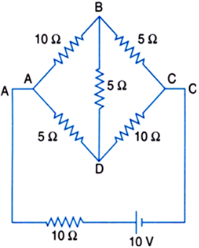
Determine the current in each branch of the network shown in Fig.:
The benches of a gallery in a cricket stadium are 1m wide and 1m high. A batsman strikes the ball at a level one metre above the ground and hits a mammoth sixer. The ball starts at 35m/s at an angle of 53° with the horizontal. The benches are perpendicular to the plane of motion and the first bench is 110m from the batsman. On which bench will the ball hit?
Find the charge required to flow through an electrolyte to liberate one atom of.
  1. A monovalent material.
  2. A divalent material.
A pitcher with 1mm thick porous walls contains 10kg of water. Water comes to its outer surface and evaporates at the rate of $0.1gs^{-1}.$ The surface area of the pitcher $($one side$)= 200cm^2.$ The room temperature = 42°C, latent heat of vaporization $ =2.27\times10^6\text{Jkg}^{-1},$ and the thermal conductivity of the porous walls $=0.80\text{Js}^{-1}\text{m}^{-1}{^{\circ}}\text{C}^{-1}.$ Calculate the temperature of water in the pitcher when it attains a constant value.
The switch S shown in figure. is kept closed for a long time and is then opened at t = 0. Find the current in the middle $1.0\Omega$ resistor at t = 1ms.