Question
Do two positively charged balls attract each other?

Answer

Yes, when the charge on the first ball is greater than that on the second ball, then due to induction some charge of opposite nature gets induced on the second ball. Therefore, the second ball will experience a force of attraction towards the first ball.

Need a full question paper?

Generate a complete, print-ready paper with questions like this in minutes — across 16+ boards, with answer keys.
Start Generating Free

Similar questions

The magnetic force on a charged particle is always perpendicular to its velocity. Can the magnetic force change the velocity of the particle? Speed of the particle?
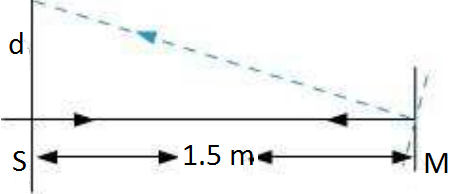
Light incident normally on a plane mirror attached to a galvanometer coil retraces backwards. A current in the coil produces a deflection of 3.5° of the mirror. What is the displacement of the reflected spot of light on a screen placed 1.5 m away?
A parallel-plate capacitor is filled with a dielectric material of resistivity ρ and dielectric constant K. The capacitor is charged and disconnected from the charging source. The capacitor is slowly discharged through the dielectric. Show that the time constant of the discharge is independent of all geometrical parameters like the plate area or separation between the plates. Find this time constant.
(a) Calculate the potential at a point $P$ located at a distance of 9 cm due to the charge $4 \times 10^{-7} C$.(b) Now, find the work done in bringing the charge $2 \times 10^{-9} C$ from infinity to point P . Does the answer depend on the path along which the charge is brought?
Consider a small cube of volume $1mm^3$ at the centre of a circular loop of radius 10cm carrying a current of 4A. Find the magnetic energy stored inside the cube.
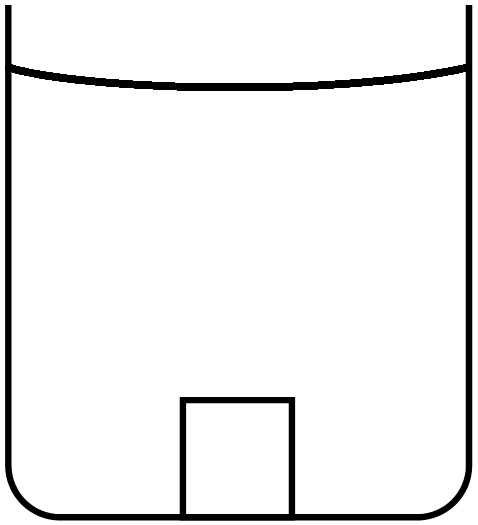
A metal piece of mass 160g lies in equilibrium inside a glass of water The piece touches the bottom of the glass at a small number of points. If the density of the metal is $8000kg/m^3$, find the normal force exerted by the bottom of the glass on the metal piece.
A nucleus $\frac{23}{10}$ Ne undergoes β− decay and becomes $\frac{23}{11}$Na. Calculate the maximum kinetic energy of electrons emitted assuming that the daughter nucleus and anti-neutrino carry negligible kinetic energy.$\left\{\text{mass of} \frac{23}{10} Ne = 22.994466 u\right\}$
$\left\{\text{mass of}\frac{23}{11}Na=22.989770u\right\}$
$\left\{ 1u = 931.5\text{MeV}/ c^{2}\right\}$
A hydrogen atom in a state having a binding energy of 0.85eV makes transition to a state with excitation energy 10.2eV (a) Identify the quantum numbers n of the upper and the lower energy states involved in the transition. (b) Find the wavelength of the emitted radiation.
A ray of light, incident on an equilateral glass prism$(\mu_{g} = \sqrt{3})$ moves parallel to the base line of the prism inside it. Find the angle of incidence for this ray.
Find the maximum Coulomb force that can act on the electron due to the nucleus in a hydrogen atom.