MCQ
Dobereiner traids is
  • A
    $Na$, $K$, $Rb$
  • B
    $Mg,$$S,$$As$
  • $Cl$, $Br,I$
  • D
    $P,$$S,$, $As$

Answer

Correct option: C.
$Cl$, $Br,I$
c
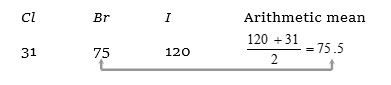
(c) According to Dobernier law of triads the atomic mass of the central element was nearly the arithmetic mean of atomic masses of other two elements.

Need a full question paper?

Generate a complete, print-ready paper with questions like this in minutes — across 16+ boards, with answer keys.

Start Generating Free

Similar questions

The most stable conformation of ethylene glycol is
Which of the following sequences contain atomic numbers of only representative elements?
For a given exothermic reaction, $K_p$ and $K'_p$  are the equilibrium constants at temperatures $T_1$ and $T_2,$ respectively. Assuming that heat of reaction is constant in temperature range between $T_1$ and $T_2,$ it is readily observed that
The heat of combustion of carbon to CO2​ is -393.5kJ/mol. The heat released upon formation of 35.2g of CO2​ from carbon and oxygen gas is:
Reactivity order of alkenes towards electrophilic addition reaction

$\mathop {C{H_2} = C{H_2}}\limits_{(I)} $   $\mathop {C{H_3} - CH = C{H_2}}\limits_{(II)} $  (figure)  $\mathop {C{H_2} = CH - Cl}\limits_{(IV)} $

For two acids $A $ and $B,\,\,p{K_a} = 1.2,\,\,p{K_b} = 2.8$ respectively in value, then which is true
Solubility of sulphates of group $-2$ elements decreases down the group due to
Given below are two statements, one is labelled as Assertion $A$ and the other is labelled as Reason $R$

Assertion $A :$- Carbon forms two important oxides $- CO$ and $CO _2 . CO$ is neutral whereas $CO _2$ is acidic in nature.

Reason $R :$- $CO _2$ can combine with water in a limited way to form carbonic acid, while $CO$ is sparingly soluble in water.

In the light of the above statements, choose the most appropriate answer from the options given below :-

Given that
$2C(s) + 2O_2(g) \to 2CO_2(g) ; \Delta H = -787\, kJ$
$H_2(g) + \frac{1}{2} O_2(g) \to H_2O(l) ; \Delta H = -286 \,kJ$
$C_2H_2(g) + 2 \frac{1}{2} O_2(g) \to 2CO_2(g) + H_2O(l)$ ;
$\Delta H = -1301\, kJ$
Heat formation of acetylene is .....$kJ$
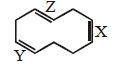
Types of geometrical isomerism shown at point $X, Y$ and $Z$ of the following compound respectively are

$X-Y-Z$