Question
Does a conductor become charged when a current is passed through it?

Answer

Yes as charge passes through it is is charged. For example we use electrical magnets in some equipment.

Need a full question paper?

Generate a complete, print-ready paper with questions like this in minutes — across 16+ boards, with answer keys.
Start Generating Free

Similar questions

In India, Domestic power supply is at 220V, 50Hz; while in USA it is 110V, 50Hz. Give one advantage and one disadvantage of 220V supply over 110V supply.
What will be the values of input A and B for the Boolean expression $\big(\overline{\text{A} + \text{B}}\big) . \big(\overline{\text{A}.\text{B}}\big) = 1?$
In a TV tube, electrons are accelerated from the rear to the front. What is the direction of the current?
A convex lens with a refractive index is placed in that medium whose refractive index is equal to the refractive index of the lens. What will be the focal length of the lens in this medium?
On a winter day the temperature of the tap water is $20^{\circ} \mathrm{C}$ whereas the room temperature is $5^{\circ} \mathrm{C}$. Water is stored in a tank of capacity $0.5 \mathrm{~m}^3$ for household use. If it were possible to use the heat liberated by the water to lift a 10 kg mass vertically, how high can it be lifted as the water comes to the room temperature? Take $\mathrm{g}=10 \mathrm{~m} \mathrm{~s}^{-2}$.
At an airport, a person is made to walk through the doorway of a metal detector, for security reasons. If she/he is carrying anything made of metal, the metal detector emits a sound. On what principle does this detector work?
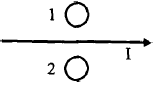
Predict the directions of induced currents in metal rings 1 and 2 lying in the same plane where current I in the wire is increasing steadily.
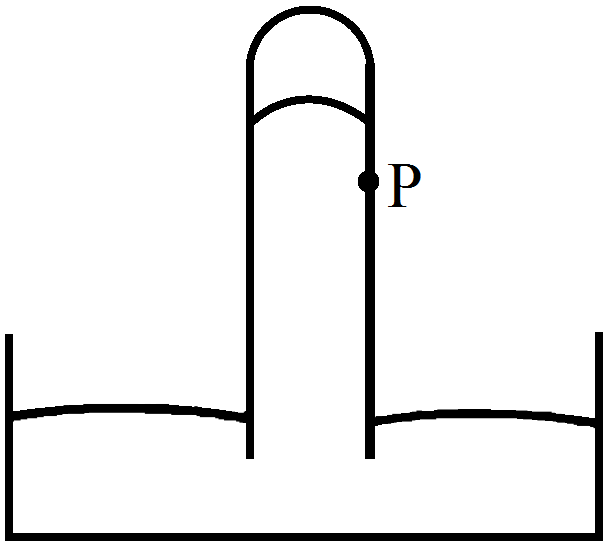
Consider the barometer shown in If a small hole is made at a point P in the barometer tube, will the mercury come out from this hole?
Drift velocity is inversely proportional to what? and it does not depend on what?
Experimental observations have shown that X-rays:
  1. Travel in vacuum with a speed of $3 \times 10^8 \mathrm{~ms}^{-1}$.
  2. Exhibit the phenomenon of diffraction and can be polarised.
What conclusion can be drawn about the nature of X-rays from each of these observations?