Question
Does a nucleus lose mass when it suffers gamma decay?

Answer

Gamma rays consist of photons that are produced when a nucleus from its excited state comes to its ground state releasing energy. Since gamma rays are chargeless and massless particles, the nucleus does not suffer any loss in mass during the gamma decay.

Need a full question paper?

Generate a complete, print-ready paper with questions like this in minutes — across 16+ boards, with answer keys.
Start Generating Free

Similar questions

Two long parallel wires are 8 cm apart. Currents of magnitudes $i$ and $3 i$ are flowing in them respectively in the same direction. Where the resultant magnetic field due to two will be zero?
The wires which connect the battery of an automobile to its starting motor carry a current of 300 A (for a short time). What is the force per unit length between the wires if they are 70 cm long and 1.5 cm apart? Is the force attractive or repulsive?
If one of the two electrons of a $H_2$ molecule is removed, we get a hydrogen molecular ion $\text{H}^+_2​.$ In the ground state of an $\text{H}^+_2​,$ the two protons are separated by roughly 1.5 Å, and the electron is roughly 1 Å from each proton. Determine the potential energy of the system. Specify your choice of the zero of potential energy.
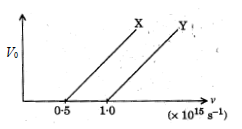
The following graph shows the variation of stopping potential $V_0$ with the frequency v of the incident radiation for two photosensitive metals X and Y:
  1. Which of the metals has larger threshold wavelength? Give reason.
  2. Explain, giving reason, which metal gives out electrons, having larger kinetic energy, for the same wavelength of the incident radiation.
  3. If the distance between the light source and metal X is halved, how will the kinetic energy of electrons emitted from it change? Give reason.
  1. State the condition under which a charged particle moving with velocity v goes undeflected in a magnetic field B.
  2. An electron, after being accelerated through a potential difference of 104 V, enters a uniform magnetic field of 0.04 T, perpendicular to its direction of motion. Calculate the radius of curvature of its trajectory.
Write any two distinguishing features between conductors, semiconductors and insulators on the basis of energy band diagrams.
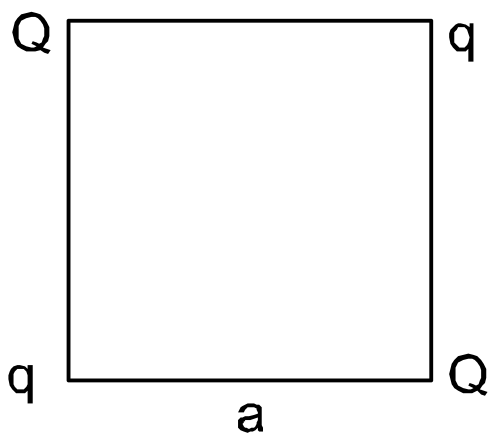
Four point charges Q, q, Q and q are placed at the corners of a square of side ‘a’ as shown in the figure.

Find the:
  1. Resultant electric force on a charge Q.
  2. Potential energy of this system.
An object is placed 15 cm in front of a convex lens of focal length 10 cm. Find the nature and position of the image formed. Where should a concave mirror of radius of curvature 20 cm be placed so that the final image is formed at the position of the object itself?
A wire of length 1m and radius 0.1mm has a resistance of $100\Omega.$ Find the resistivity of the material.
In a Geiger - Marsden experiment, calculate the distance of closest approach to the nucleus of Z = 80, when an α-particle of 8 MeV nergy impinges on it before it comes momentarily to rest and reverses its direction.
How will the distance of closest approach be affected when the kinetic energy of the α-particle is doubled?