Question
Does light factor affect the distribution of organisms? Write a brief note giving suitable examples of either plants or animals.

Answer

Since plants produce food through photosynthesis, a process which is only possible when sunlight is available as a source of energy, we can quickly understand the importance of light for living organisms, particularly autotrophs. Many species of small plants (herbs and shrubs) growing in forests are adapted to photosynthesise optimally under very low light conditions because they are constantly overshadowed by tall, canopied trees. Many plants are also dependent on sunlight to meet their photoperiodic requirement for flowering. For many animals too, light is important in that they use the diurnal and seasonal variations in light intensity and duration (photoperiod) as cues for timing their foraging, reproductive and migratory activities.
Need a full question paper?

Generate a complete, print-ready paper with questions like this in minutes — across 16+ boards, with answer keys.

Start Generating Free

Similar questions

Explain the difference between apes and human.
Write a short note on pyramid of numbers and pyramid of biomass.
Read the following and answer any four questions from (i) to (v) given below:
Apomixis is a mode of reproduction which does not involve formation of zygote through gametic fusion. In plants, apomixis commonly mimics sexual reproduction but produces seeds without fertilization. There are several methods of atomistic development in seeds. Thee two common ones are recurrent agamospermy and advective embryony.
  1. Apomixis is a type of reproduction in plants, in which?
  1. Fertilization does not take place.
  2. Male nucleus takes part in fertilization.
  3. Pollen fusion takes place.
  4. Generative nucleus takes part in fertilization.
  1. Which of the following statements is incorrect regarding recurrent agamospermy?
  1. It is the formation of seed that has an embryo formed without meiosis and syngamy.
  2. All the cells of embryo sac are diploid.
  3. An embryo develops directly from a diploid cell other than egg like that of nucleus and integument.
  4. None of these.
  1. Adventive embryony is found in:
  1. Citrus.
  2. Opuntia.
  3. Apple.
  4. Both (a) and (b).
  1. Formation of embryo directly from diploid egg without fertilization is called:
  1. Apospory.
  2. Diplospory.
  3. Polyembryony.
  4. Diploid parthenogenesis.
  1. If any somatic cell of sporophyte produces gametophyte without reduction division, it is called:
  1. Parthenogenesis.
  2. Apogamy.
  3. Apospory.
  4. Amphimixis.

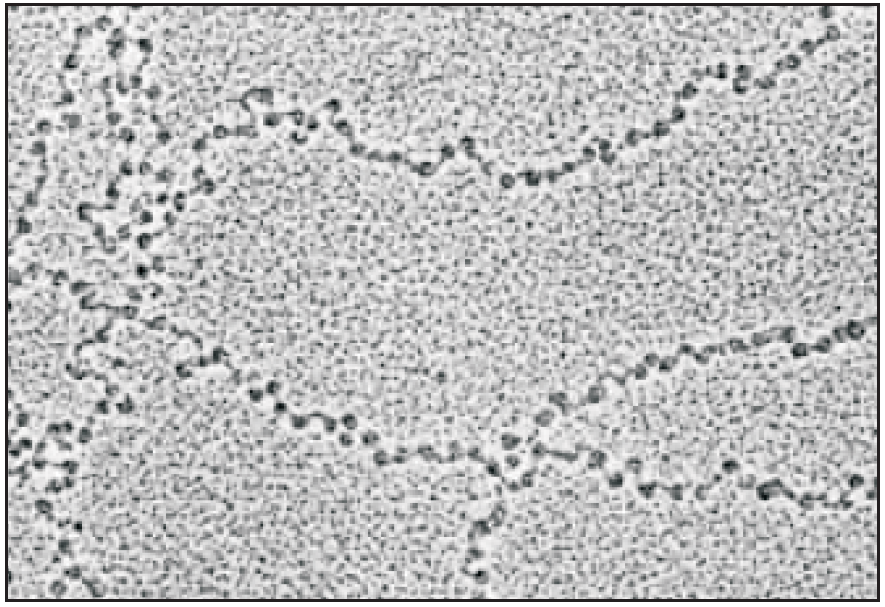
Shown above is the electron micrograph (EM) picture of 'beads-on-string'.
  1. Identify and explain the detailed structure of a bead with the help of a labelled diagram.
  2. Describe the packaging of 'beads-on-string'in a eukaryotic cell.
Differentiate between:
  1. Predator and parasite.
  2. S-Shaped and J-Shaped growth curve.
Enumerate the factors which are necessary to maintain good health.
Can you list 10 recombinant proteins which are used in medical practice? Find out where they are used as therapeutics (use the internet).
What is innate immunity? How is it accomplished in a human body?
List the various abiotic environmental factors.
During the biology class on theories of evolution, the teacher was telling about Lamarckism. Katy was confused after listening to it and went to her teacher to clear her doubts. She asked if characters can be passed to generations, then why she does not have the tatoo that her mother has on her arm. The teacher smiled and told Katy that this is the reason why Lamarck's theory was rejected. The teacher explained her the other theories as well.
  1. Name the book in which Lamarckism was explained.
  2. What are the three factors of this theory?
  3. What are the other theories of evolution?
  4. What are the values shown by teacher?