Question
Does the line 3x − 5y = 6 bisect the join of (5, −2) and (−1, 2)?

Answer

The given line will bisect the join of A (5, −2) and B (−1, 2), if the co-ordinates of the mid-point of AB satisfy the equation of the
line.
The co-ordinates of the mid-point of AB are
$\left(\frac{5-1}{2}, \frac{-2+2}{2}\right)=(2,0)$
Substituting x = 2 and y = 0 in the given equation, we have:
L.H.S. = 3x − 5y
= 3(2) − 5(0)
= 6 − 0
= 6 = R.H.S.
Hence, the line 3x − 5y = 6 bisect the join of (5, −2) and (−1, 2).

Need a full question paper?

Generate a complete, print-ready paper with questions like this in minutes — across 16+ boards, with answer keys.
Start Generating Free

Similar questions

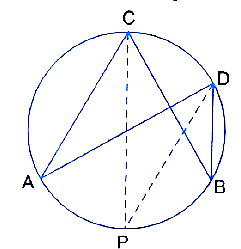
In the figure, given alongside, CP bisects angle ACB. Show that DP bisects angle ADB.
An aeroplane when $3,000$ meters high passes vertically above another aeroplane at an instance when their angles of elevation at the same observation point are $60°$ and $45°$ respectively. How many meters higher is the one than the other?
Find the sums given below : 34 + 32 + 30 + … + 10
(i) Point P(a, b) reflected on the X-axis to P'(5, 2). Write down the value of a and b.
(ii) P” is the image of P when reflected on the Y-axis. Write down the co-ordinates of P”.
(iii) Name a single transformation that maps P’ to P”.
Solve each of the following equations using the formula:
$\frac{4}{x}-3=\frac{5}{2 x+3}$
If AB and CD are two chords which when produced meet at P and if AP = CP, show that AB = CD.
Solve $\frac{2 x+1}{2}+2(3-x) \geq 7, x \in R$. Also graph the solution set on the number line
A person bought 360 ten - rupee shares paying $12 \%$ dividend at par and sold them at ₹ $ 21$. The proceeds were invested in five - rupee shares paying $4 \frac{1}{2} \%$ at ₹ $ 3.5$ per share. Find (i) sale proceeds (ii) the number of five - rupee shares bought (iii) the percentage increase in income.
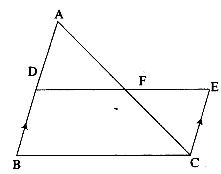
In the given figure $ABC$ and $CEF$ are two triangles where $BA$ is parallel to $CE$ and $AF: AC = 5: 8.$

(i) Prove that $\triangle ADF \sim \triangle CEF$
(ii) Find $AD$ if $CE = 6 cm$
(iii) If $DF$ is parallel to $BC$ find area of $\triangle ADF:$ area of $\triangle ABC.$
 If the angles of a triangle are in the ratio 2 : 3 : 4, find the angles.