MCQ
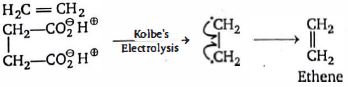
$\begin{array}{*{20}{c}}
  {C{H_2} - C{O_2}K} \\ 
  {|\,\,\,\,\,\,\,\,\,\,\,\,\,\,\,\,\,\,\,\,\,\,\,\,\,\,} \\ 
  {C{H_2} - C{O_2}K} 
\end{array}\xrightarrow{{electrolysis}}\mathop {(A)}\limits_{\left( {major} \right)} $ (Kolbe electrolysis method)

Product $(A)$ of the reaction is 

  • A
    $CH_3 - CH_3$
  • $CH_2 = CH_2$
  • C
    $CH_3 -CH = CH_2$
  • D
    none of these

Answer

Correct option: B.
$CH_2 = CH_2$
b

Need a full question paper?

Generate a complete, print-ready paper with questions like this in minutes — across 16+ boards, with answer keys.

Start Generating Free

Similar questions

Which one is the strongest acid
The reaction $A\xrightarrow{K}{\text{Product,}}$ is zero order while the reaction $B\xrightarrow{K}{\text{Product,}}$ is first order, for what initial concentration of $A$, the half lives of the two reactions will be equal ?
Temperature dependent equation can be written as
$IUPAC$ name of
The high boiling point of ethanol $({78.2\,^o}C)$ compared to dimethyl ether$( - {23.6\,^o}C)$, though both having the same molecular formulae ${C_6}{H_6}O$, is due to
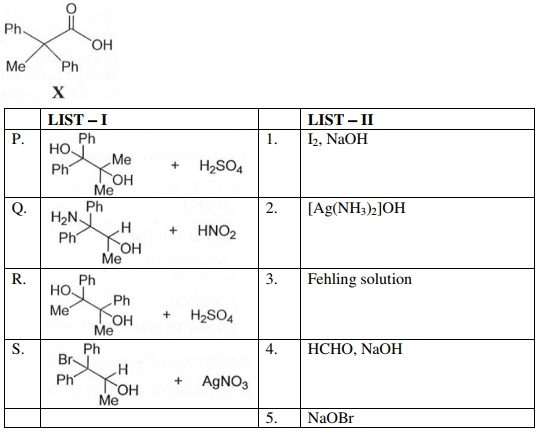
The desired product $X$ can be prepared by reacting the major product of the reactions in $LIST-I$ with one or more appropriate reagents in $LIST-II$. (given, order of migratory aptitude: aryl > alkyl > hydrogen)

(image)

The correct option is

Which of the following molecules have non-zero dipole moments ?

$(I)$ gauche conformation of $1, 2$ -dibromoethane

$(II)$ anti conformation of $1, 2$ -dibromoethane

$(III)$ trans- $1, 4$ -dibromocyclohexane

$(IV)$ cis- $1, 4$ -dibromocyclohexane

$(V)$ tetrabromomethane

$(VI)$ $1, 1$ -dibromocyclohexane

$A$ and $B$ formed in the following reactions are:$\mathrm{CrO}_2 \mathrm{Cl}_2+4 \mathrm{NaOH} \rightarrow \mathrm{A}+2 \mathrm{NaCl}+2 \mathrm{H}_2 \mathrm{O} \mathrm{A}+2 \mathrm{HCl}+2 \mathrm{H}_2 \mathrm{O}_2 \rightarrow \mathrm{B}+3 \mathrm{H}_2 \mathrm{O}$
A solution contains $KCl$ in water. It is heated continuously and vapour formed is removed continuously. Vapour pressure of solution will be
Total number of species from the following which can undergo disproportionation reaction________.

$\mathrm{H}_2 \mathrm{O}_2, \mathrm{ClO}_3^{-}, \mathrm{P}_4, \mathrm{Cl}_2, \mathrm{Ag}, \mathrm{Cu}^{+1}, \mathrm{~F}_2, \mathrm{NO}_2, \mathrm{~K}^{+}$