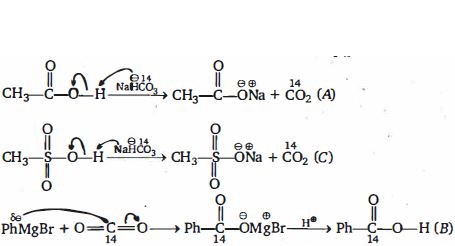
MCQ
$\begin{gathered}
\begin{array}{*{20}{c}}
{O\,\,\,\,\,\,\,\,\,\,\,\,\,\,\,\,\,\,\,\,\,\,\,\,\,\,\,\,\,\,\,\,\,\,\,\,\,\,\,\,\,\,\,\,\,\,\,\,\,\,\,\,\,\,\,\,\,\,\,\,\,\,\,\,\,\,\,\,\,\,\,\,\,\,} \\
{||\,\,\,\,\,\,\,\,\,\,\,\,\,\,\,\,\,\,\,\,\,\,\,\,\,\,\,\,\,\,\,\,\,\,\,\,\,\,\,\,\,\,\,\,\,\,\,\,\,\,\,\,\,\,\,\,\,\,\,\,\,\,\,\,\,\,\,\,\,\,\,\,\,\,} \\
{C{H_3} - {\text{ }}C - {\text{ }}O - H\xrightarrow{{NaH{{\mathop {CO}\limits^{14} }_3}}}\mathop {(A)}\limits_{(gas)} \xrightarrow[{(ii){H_3}{O^ \oplus }}]{{(i)PhMgBr}}(B)}
\end{array} \hfill \\
\begin{array}{*{20}{c}}
{O\,\,\,\,\,\,\,\,\,\,\,\,\,\,\,\,\,\,\,\,\,\,\,\,\,\,\,\,\,\,\,\,\,\,\,\,\,\,\,\,\,\,\,\,\,\,\,\,\,\,\,\,\,\,\,\,\,\,\,\,\,\,\,\,\,\,\,\,\,\,\,\,\,\,} \\
{||\,\,\,\,\,\,\,\,\,\,\,\,\,\,\,\,\,\,\,\,\,\,\,\,\,\,\,\,\,\,\,\,\,\,\,\,\,\,\,\,\,\,\,\,\,\,\,\,\,\,\,\,\,\,\,\,\,\,\,\,\,\,\,\,\,\,\,\,\,\,\,\,\,\,} \\
{C{H_3} - S - O - H\xrightarrow{{NaH\mathop {C{O_3}}\limits^{14} }}\mathop {(C)}\limits_{(gas)} \xrightarrow[{(ii){H_3}{O^ \oplus }}]{{(i)PhMgBr}}(D)} \\
{||\,\,\,\,\,\,\,\,\,\,\,\,\,\,\,\,\,\,\,\,\,\,\,\,\,\,\,\,\,\,\,\,\,\,\,\,\,\,\,\,\,\,\,\,\,\,\,\,\,\,\,\,\,\,\,\,\,\,\,\,\,\,\,\,\,\,\,\,\,\,\,\,\,\,\,} \\
{O\,\,\,\,\,\,\,\,\,\,\,\,\,\,\,\,\,\,\,\,\,\,\,\,\,\,\,\,\,\,\,\,\,\,\,\,\,\,\,\,\,\,\,\,\,\,\,\,\,\,\,\,\,\,\,\,\,\,\,\,\,\,\,\,\,\,\,\,\,\,\,\,\,\,\,\,}
\end{array} \hfill \\
\end{gathered}$
\begin{array}{*{20}{c}}
{O\,\,\,\,\,\,\,\,\,\,\,\,\,\,\,\,\,\,\,\,\,\,\,\,\,\,\,\,\,\,\,\,\,\,\,\,\,\,\,\,\,\,\,\,\,\,\,\,\,\,\,\,\,\,\,\,\,\,\,\,\,\,\,\,\,\,\,\,\,\,\,\,\,\,} \\
{||\,\,\,\,\,\,\,\,\,\,\,\,\,\,\,\,\,\,\,\,\,\,\,\,\,\,\,\,\,\,\,\,\,\,\,\,\,\,\,\,\,\,\,\,\,\,\,\,\,\,\,\,\,\,\,\,\,\,\,\,\,\,\,\,\,\,\,\,\,\,\,\,\,\,} \\
{C{H_3} - {\text{ }}C - {\text{ }}O - H\xrightarrow{{NaH{{\mathop {CO}\limits^{14} }_3}}}\mathop {(A)}\limits_{(gas)} \xrightarrow[{(ii){H_3}{O^ \oplus }}]{{(i)PhMgBr}}(B)}
\end{array} \hfill \\
\begin{array}{*{20}{c}}
{O\,\,\,\,\,\,\,\,\,\,\,\,\,\,\,\,\,\,\,\,\,\,\,\,\,\,\,\,\,\,\,\,\,\,\,\,\,\,\,\,\,\,\,\,\,\,\,\,\,\,\,\,\,\,\,\,\,\,\,\,\,\,\,\,\,\,\,\,\,\,\,\,\,\,} \\
{||\,\,\,\,\,\,\,\,\,\,\,\,\,\,\,\,\,\,\,\,\,\,\,\,\,\,\,\,\,\,\,\,\,\,\,\,\,\,\,\,\,\,\,\,\,\,\,\,\,\,\,\,\,\,\,\,\,\,\,\,\,\,\,\,\,\,\,\,\,\,\,\,\,\,} \\
{C{H_3} - S - O - H\xrightarrow{{NaH\mathop {C{O_3}}\limits^{14} }}\mathop {(C)}\limits_{(gas)} \xrightarrow[{(ii){H_3}{O^ \oplus }}]{{(i)PhMgBr}}(D)} \\
{||\,\,\,\,\,\,\,\,\,\,\,\,\,\,\,\,\,\,\,\,\,\,\,\,\,\,\,\,\,\,\,\,\,\,\,\,\,\,\,\,\,\,\,\,\,\,\,\,\,\,\,\,\,\,\,\,\,\,\,\,\,\,\,\,\,\,\,\,\,\,\,\,\,\,\,} \\
{O\,\,\,\,\,\,\,\,\,\,\,\,\,\,\,\,\,\,\,\,\,\,\,\,\,\,\,\,\,\,\,\,\,\,\,\,\,\,\,\,\,\,\,\,\,\,\,\,\,\,\,\,\,\,\,\,\,\,\,\,\,\,\,\,\,\,\,\,\,\,\,\,\,\,\,\,}
\end{array} \hfill \\
\end{gathered}$
Product $(B)$ and $(D) $ in the above reaction are
- A$\begin{array}{*{20}{c}}
{O\,\,\,\,\,\,\,\,\,} \\
{||\,\,\,\,\,\,\,\,\,\,} \\
{Ph - C - O - H,\,}
\end{array}$ $\begin{array}{*{20}{c}}
O \,\,\,\,\,\,\,\,\,\\
{||} \,\,\,\,\,\,\,\,\,\\
{Ph - S - O - H} \\
{||}\,\,\,\,\,\,\,\,\, \\
O\,\,\,\,\,\,\,\,\,
\end{array}$ - B$\begin{array}{*{20}{c}}
{O\,\,\,\,\,\,\,\,\,\,\,}\\
{||\,\,\,\,\,\,\,\,\,\,\,}\\
{Ph - \mathop C\limits_{14} - O - H,\,}
\end{array} $ $\begin{array}{*{20}{c}}
{O\,\,\,\,\,\,}\\
{||\,\,\,\,\,\,\,}\\
{Ph - S - O - H}
\end{array}$ - ✓$\begin{array}{*{20}{c}}
{O\,\,\,\,\,\,\,\,\,\,\,}\\
{||\,\,\,\,\,\,\,\,\,\,\,}\\
{Ph - \mathop C\limits_{14} - O - H,\,}
\end{array} $ $\underset{14}{\mathop{\begin{matrix}
O\,\,\,\,\,\, \\
||\,\,\,\,\,\,\, \\
Ph-C-O-H \\
\end{matrix}}}\,$ - D$\begin{matrix}
\,\,\,\,\,\,\,\,O\,\,\,\,\,\,\,\, \\
\,\,\,\,\,\,||\,\,\,\,\,\,\,\, \\
Ph-\text{ }C-OH, \\
\end{matrix}$ $\begin{array}{*{20}{c}}
{O\,\,\,\,\,\,}\\
{||\,\,\,\,\,\,\,}\\
{Ph - S - O - H}
\end{array}$