MCQ
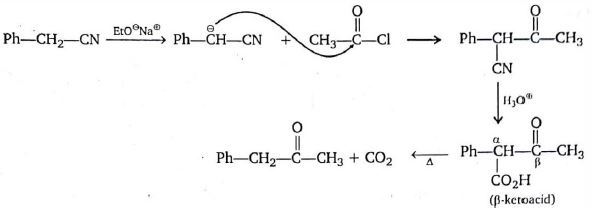
$Ph-C{{H}_{2}}-CN\xrightarrow[\begin{smallmatrix} 
 \begin{matrix}
   \,\,\,\,\,\,\,\,\,\,\,\,\,\,\,\,\,\,O  \\
   \,\,\,\,\,\,\,\,\,\,\,\,\,\,\,\,\,\,||  \\
   (2)\,C{{H}_{3}}-C-Cl  \\
\end{matrix} \\ 
 (3)\,{{H}_{3}}{{O}^{\oplus }}/\Delta  
\end{smallmatrix}]{(1)\,EtONa}(P);$ Product $(P)$ of the reaction will be
  • A
    $\begin{matrix}
       \,\,\,\,\,\,\,\,\,\,\,\,\,\,\,\,\,\,O  \\
       \,\,\,\,\,\,\,\,\,\,\,\,\,\,\,\,\,||  \\
       Ph-C{{H}_{2}}-C-H  \\
    \end{matrix}$
  • $\begin{matrix}
       \,\,\,\,\,\,\,\,\,\,\,\,\,\,O  \\
       \,\,\,\,\,\,\,\,\,\,\,\,\,||  \\
       Ph-C{{H}_{2}}-C-C{{H}_{3}}  \\
    \end{matrix}$
  • C
    $\begin{matrix}
       \,\,\,\,\,\,\,\,\,\,\,\,\,\,\,\,\,\,\,\,\,O  \\
       \,\,\,\,\,\,\,\,\,\,\,\,\,\,\,\,\,\,\,\,||  \\
       Ph-CH-C-H  \\
       |\,\,\,\,\,\,\,\,\,\,\,\,\,\,  \\
       C{{H}_{3}}\,\,\,\,\,\,\,\,  \\
    \end{matrix}$
  • D
    $\begin{matrix}
       \,\,\,\,\,\,\,\,\,\,\,\,\,\,\,O  \\
       \,\,\,\,\,\,\,\,\,\,\,\,\,\,||  \\
       Ph-CH-C-C{{H}_{3}}  \\
       |\,\,\,\,\,\,\,\,\,\,\,\,\,\,\,\,\,\,  \\
       C{{H}_{3}}\,\,\,\,\,\,\,\,\,\,\,\,\,  \\
    \end{matrix}$
Answer

Correct option: B.
$\begin{matrix}
   \,\,\,\,\,\,\,\,\,\,\,\,\,\,O  \\
   \,\,\,\,\,\,\,\,\,\,\,\,\,||  \\
   Ph-C{{H}_{2}}-C-C{{H}_{3}}  \\
\end{matrix}$
b

Need a full question paper?

Generate a complete, print-ready paper with questions like this in minutes — across 16+ boards, with answer keys.

Start Generating Free

Similar questions

A metal block is exposed to beams of $X-$ ray of different wavelength. $X-$ rays of which wavelength penetrate most.......$\mathop A\limits^o $
Force $(F)$ and density $(d)$ are related as $F\, = \,\frac{\alpha }{{\beta \, + \,\sqrt d }}$ then dimension of $\alpha $ are
A wave represented by the given equation $y = a\cos (kx - \omega \,t)$ is superposed with another wave to form a stationary wave such that the point $x = 0$ is a node. The equation for the other wave is
What will be the formula of mass of the earth in terms of $g, R$ and $G$ ?
The north pole of a bar magnet is moved swiftly downward towards a closed coil and then second time it is raised upwards slowly. The magnitude and direction of the induced currents in the two cases will be of   

 First case               Second case

If the threshold of hearing is assumed to be the reference $(0\ dB)$ , then the threshold of pain is taken to be $120\ dB$ . Let the corresponding sound intensities be $I_0$ and $I$ respectively. Then $\frac{{{I_0}}}{I}$ is 
A convex lens (of focal length $20\, cm$) and a concave mirror, having their principal axes along the same lines, are kept $80\, cm$ apart from each other. The concave mirror is to the right of the convex lens. When an object is kept at a distance of $30\, cm$ to the left of the convex lens, its image remains at the same position even if the concave mirror is removed. The maximum distance of the object for which this concave mirror, by itself would produce a virtual image would be.....$cm$
A material '$B$' has twice the specific resistance of '$A$'. A circular wire made of '$B$' has twice the diameter ofa wire made of '$A$'. then for the two wires to have the same resistance, the ratio $\frac{{{l_B}}}{{{l_A}}}$ of their respective lengths must be
Sound wave travels with a velocity of $300\, m\, s^{-1}$ through a gas. $9\, beats$ are produced in $3\, s$ when two waves pass through it simultaneously. If one of the waves has $2\, m$ wavelength, the wavelength of the other wave is ..... $m$
The force constants of two springs are ${K_1}$ and ${K_2}$. Both are stretched till their elastic energies are equal. If the stretching forces are ${F_1}$ and ${F_2}$, then ${F_1}:{F_2}$ is