MCQ
Domain of the function $f(x) = \sqrt {2 - {{\sec }^{ - 1}}x} $ is
  • A
    $\left( { - \infty , - 1} \right] \cup \left[ {1,\infty } \right)$
  • B
    $\left( { - \infty , - 1} \right] \cup \left[ {\sec 1,\infty } \right)$
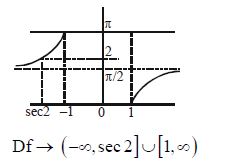
  • $\left( { - \infty ,\sec 2} \right] \cup \left[ {1,\infty } \right)$
  • D
    $\left( { - \infty ,\sec 2} \right] \cup \left[ {\sec 1,\infty } \right)$

Answer

Correct option: C.
$\left( { - \infty ,\sec 2} \right] \cup \left[ {1,\infty } \right)$
c

Need a full question paper?

Generate a complete, print-ready paper with questions like this in minutes — across 16+ boards, with answer keys.

Start Generating Free

Similar questions

Let the line $\mathrm{L}$ intersect the lines

$\mathrm{x}-2=-\mathrm{y}=\mathrm{z}-1,2(\mathrm{x}+1)=2(\mathrm{y}-1)=\mathrm{z}+1$

and be parallel to the line $\frac{x-2}{3}=\frac{y-1}{1}=\frac{z-2}{2}$.

Then which of the following points lies on $\mathrm{L}$ ?

If $x = \int\limits_0^y {\frac{{dt}}{{\sqrt {1 + {t^2}} }}} $, then $\frac{{{d^2}y}}{{d{x^2}}}$ is equal to 
If $\text{f(x)}=\begin{vmatrix}0&\text{x}-\text{a}&\text{x}-\text{b}\\\text{x}+\text{a}&0&\text{x}-\text{c}\\\text{x}+\text{b}&\text{x}+\text{c}&0\end{vmatrix},$ then:
  1. f(a) = 0
  2. f(b) = 0
  3. f(0) = 0
  4. f(1) = 0
If $\overline E$ and $\overline F$ are the complementary events of events $E$ and $F$ respectively and if $0 < P\,(F) < 1,$ then
If $A=\left[\begin{array}{lll}2 & -3 & 4\end{array}\right], B=\left[\begin{array}{l}3 \\ 2 \\ 2\end{array}\right], X=\left[\begin{array}{lll}1 & 2 & 3\end{array}\right]$ and $Y=\left[\begin{array}{l}2 \\ 3 \\ 4\end{array}\right]$, then $A B+X Y$ equals
Considering only the principal values, if $\tan ({\cos ^{ - 1}}x)$ $ = \sin \left[ {{{\cot }^{ - 1}}\left( {\frac{1}{2}} \right)} \right]$, then $x$ is equal to
Let $f$ be a twice differentiable function defined on $R$ such that $f (0)=1, f ^{\prime}(0)=2$ and $f ^{\prime}( x ) \neq 0$ for all $x \in R$. If $\left|\begin{array}{ll}f(x) & f^{\prime}(x) \\ f^{\prime}(x) & f^{\prime \prime}(x)\end{array}\right|=0,$ for all $x \in R,$ then the value of $f (1)$ lies in the interval:
The value of $\int_{\,0}^{\,\pi /2} {{{\left( {\sqrt {\sin \theta } \cos \theta } \right)}^3}d\theta } $ is
Choose the correct answer in Exercise:
$\int\frac{\cos2\text{x}}{(\sin\text{x}+\cos\text{x)}^{2}}$ is equal to
  1. $\frac{-1}{\sin\text{x}+\cos\text{x}}+\text{C}$
  2. $\log|\sin\text{x}+\cos\text{x}|+\text{C}$
  3. $\log|\sin\text{x}-\cos\text{x}|+\text{C}$
  4. $\frac{1}{(\sin\text{x}+\cos\text{x)}^{2}}+\text{C}$
$\int\limits^\frac{\pi}{2}_0\frac{1}{2+\cos\text{x}}\text{ dx}$ equals:

  1. $\frac{1}{3}\tan^{-1}\Big(\frac{1}{\sqrt{3}}\Big)$

  2. $\frac{2}{\sqrt{3}}\tan^{-1}\Big(\frac{1}{\sqrt{3}}\Big)$

  3. ${\sqrt{3 }}\tan^{-1}\big({\sqrt{3}}\big)$

  4. $2{\sqrt{3 }}\tan^{-1}{\sqrt{3}}$