Doppler effect is applicable for
Easy


Download our appand get started for free
Experience the future of education. Simply download our apps or reach out to us for more information. Let's shape the future of learning together!No signup needed.*
Similar Questions
- 1An observer is riding on a bicycle and moving towards a hill at $18\,km\,h ^{-1}$. He hears a sound from a source at some distance behind him directly as well as after its reflection from the hill. If the original frequency of the sound as emitted by source is $640\,\,Hz$ and velocity of the sound in air is $320\,m / s$, the beat frequency between the two sounds heard by observer will be $...Hz$.View Solution
- 2The displacement y of a particle in a medium can be expressed as: $y = {10^{ - 6}}\sin (100t + 20x + \pi /4)m,$ where $t$ is in second and $x$ in meter. The speed of wave is ... $m/s$View Solution
- 3View SolutionVelocity of sound in air is
- 4View SolutionDecibel is unit of
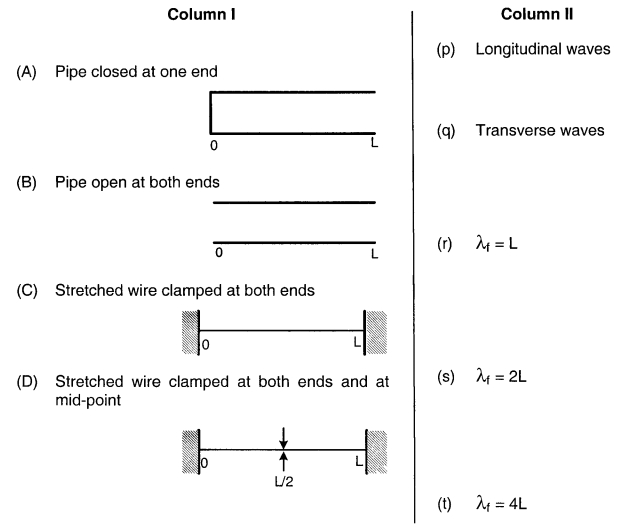
- 5Column $I$ shows four systems, each of the same length $L$, for producing standing waves. The lowest possible natural frequency of a system is called its fundamental frequency, whose wavelength is denoted as $\lambda_{ f }$. Match each system with statements given in Column $II$ describing the nature and wavelength of the standing waves.View Solution
- 6The equation of displacement of two waves are given as ${y_1} = 10\sin \left( {3\pi t + \frac{\pi }{3}} \right)$; ${y_2} = 5(\sin 3\pi t + \sqrt 3 \cos 3\pi t)$. Then what is the ratio of their amplitudesView Solution
- 7A uniform string oflength $20\ m$ is suspended from a rigid support. A short wave pulse is introduced at its lowest end. It starts moving up the string. The time taken to reach the supports is (take $g= 10 $ $ms^{-2}$ )View Solution
- 8View SolutionIn a stretched string,
- 9$Assertion :$ Doppler formula for sound wave is symmetric with respect to the speed of source and speed of observer.View Solution
$Reason :$ Motion of source with respect to stationary observer is not equivalent to the motion of an observer with respect to stationary source. - 10A progressive wave travelling in positive by $x-$ direction given by $y = a\, sin (kx -\omega t)$ meets fixed end at $x = 0$. The reflected wave may be given byView Solution