MCQ
Doppler shift in frequency does not depend upon
  • A
    The frequency of the wave produced
  • B
    The velocity of the source
  • C
    The velocity of the observer
  • Distance from the source to the listener

Answer

Correct option: D.
Distance from the source to the listener
d
Change of frequency due to the Doppler effect is : $=n(\quad)$. This is independent of distance between source and observer.

Need a full question paper?

Generate a complete, print-ready paper with questions like this in minutes — across 16+ boards, with answer keys.
Start Generating Free

Similar questions

A particle executes simple hormonic motion between $x =\, -A$ and $x = +A$ . It starts from $x = 0$ moves in $+x-$ direction. The time taken for it to move from $x = 0$ to $x = \frac {A}{2}$ is $T_1$ and to move from $\frac {A}{2}$ to $\frac {A}{\sqrt 2}$ is $T_2$ , then
Dimensions of frequency are
A uniform bar of square cross$-$section is lying along a frictionless horizontal surface. A horizontal force is applied to pull it from one of its ends, then:
An electric fan has blades of length $30 \,cm$ as measured from the axis of rotation. If the fan is rotating at $1200\,$ r.p.m. , the acceleration of a point on the tip of the blade is about ..........  $m/sec^2$
An ideal gas of Molar mass $M$ is contained in a vertical tube of height $H$, closed at both ends. The tube is accelerating vertically upwards with acceleration $g$ Then, the ratio of pressure at the bottom and the mid point of the tube will be
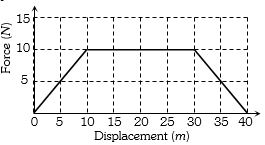
Adjacent figure shows the force-displacement graph of a moving body, the work done in displacing body from $x = 0$ to $x = 35\,m$ is equal to ........... $J$
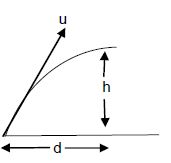
If a stone is to hit at a point which is at a distance $d$ away and at a height $h$ above the point from where the stone starts, then what is the value of initial speed $u$ if the stone is launched at an angle $\theta $ ?
The mean radius of the earth is $R,$ its angular speed about its own axis is $o$ and the acceleration due to gravity at earth surface is $g.$ The cube of radius of orbit of 'geostationary satellite' will be:
If the current is doubled, the deflection is also doubled in:
If a gas is heated at constant pressure, its isothermal compressibility