MCQ
Doppler's effect will not be applicable when the velocity of sound source is
  • A
    Equal to that of the sound velocity
  • B
    Less than the velocity of sound
  • Greater than the velocity of sound
  • D
    Zero

Answer

Correct option: C.
Greater than the velocity of sound
c
(c) Doppler's effect will not be applicable when the velocity of sound source is greater than the velocity of sound.

Need a full question paper?

Generate a complete, print-ready paper with questions like this in minutes — across 16+ boards, with answer keys.
Start Generating Free

Similar questions

Due to some force $F_1$ a body oscillates with period $4/5\, sec$ and due to other force $F_2$ oscillates with period $3/5\, sec$. If both forces act simultaneously, the new period will be .... $\sec$
In a certain thermodynamical process, the pressure of a gas depends on its volume as $kV ^{3}$. The work done when the temperature changes from $100^{\circ} C$ to $300^{\circ} C$ will be .......... $nR$, where $n$ denotes number of moles of a gas.
If 3 forces F1, F2 and F3 act on a particle, then in equilibrium ______.
The specific heat of a gas at constant pressure is more than that of the same gas at constant volume because
Mass is distributed uniformly over a thin square plate. If two end points of diagonal are $(-2, 0)$ and $(2, 2)$, what are the coordinates of centre of mass of plate ?
At constant volume, for different diatomic gases the molar specific heat is
Two vectors of magnitude $3$ & $4$ have resultant which make angle $\alpha$ & $\beta$ respectively with them $\{given\, \alpha + \beta \neq 90^o\}$
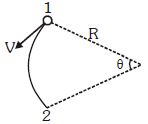
A ring of mass $m$ moves from point $1$ to point $2$ along a smooth rigid horizontal wire with a constant speed $v$. The average force acting the ring over the time of its motion from $1$ to $2$ is
The distance between Sun and Earth is $R.$ The duration of year if the distance between Sun and Earth becomes $3R$ will be 
According to Newton’s law of cooling, the rate of cooling of a body is proportional to ${(\Delta \theta )^n}$, where $\Delta \theta $ is the difference of the temperature of the body and the surroundings, and n is equal to