Question
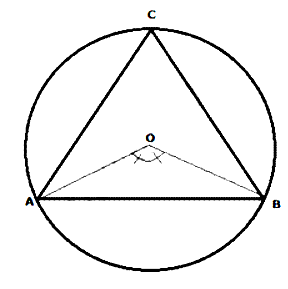
Draw a circle with radius 3 cm and inscribe an equilateral triangle in it.

Answer


Steps of construction:
(i) Draw a drde with centre 0 and radius= 3 cm.
(ii) Draw radii OA and OB sudi that LAOB = (360/3) = 120°
(iii) Join AB. Cut off arcs AC and BC equal to AB.
(iv) Join AC and BC.
Δ ABC is the required equilateral triangle.

Need a full question paper?

Generate a complete, print-ready paper with questions like this in minutes — across 16+ boards, with answer keys.
Start Generating Free

Similar questions

A company, with 10,000 shares of Rs 100 each, declares an annual dividend of 5%.
(1) What is the total amount of dividend paid by the company?
(2) What should be the annual income of a man who has 72 shares in the company?
(3) If he received only 4% of his investment, find the price he paid for each share
Find the sub-duplicate ratio of the following:
$\frac{1}{16}: \frac{1}{36}$
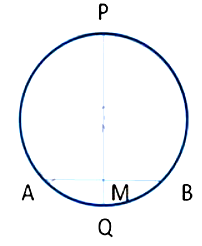
In following figure , AB , a chord of the circle is of length $18 \ cm$. It is perpendicularly bisected at M by $PQ.$
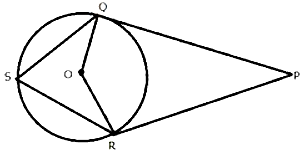
In the following figure, PQ and PR are tangents to the circle, with centre O. If ∠ QPR = 60° , calculate:
∠ OQR 
One root of the quadratic equation $8 x^2+m x+15=0$ is $\frac{3}{4}$ Find the value of m. Also, find the other root of the equation.
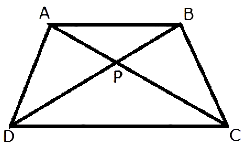
The given figure shows a trapezium in which $AB$ is parallel to $DC$ and diagonals $AC$ and $BD$
intersect at point $P$. If $AP : CP = 3: 5,$

Find:
$(1) \triangle APB : \triangle CPB$
$(2 ) \triangle DPC : \triangle APB$
$(3) \triangle ADP : \triangle APB $
​​​​​​​$(4) \triangle APB : \triangle ADB$
The mean of the following distribution is $21 \frac{1}{7}$. find the value of $f$
C.I 0-10 20-Oct 20-30 30-40 40-50
Freq 8 22 31 f 2
In  Δ PQR, s is a point on PR such that ∠ PQS = ∠  RQS . Prove thats is equidistant from PQ and QR. 
OABC is a rhombus whose three vertices A, B and C lie on a circle with centre O.
(ii) If the area of the rhombus is 32 3 cm2 find the radius of the circle.
If $\overline{ X }$ is the mean of n observations $x_1, x_2, x_3,..., x_n$ then the mean of $\frac{x_1}{ a }, \frac{x_2}{ a }, \frac{x_3}{ a }, \ldots, \frac{x_{ n }}{ a }$ is $\frac{\overline{ X }}{ a }$, where $a$ is an
non-zero number.
i.e., if each observation is divided by a non-zero number, then the mean is also divided by it.