Question
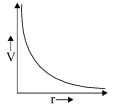
Draw a graph showing the change in potential corresponding to the change in distance from a point charge. For the charged system shown in the figure, prove that the potential difference between points $A$ and $B$ is

Image

Answer

In the figure, the potential at point A due to $+q$ and $-q$ charges respectively is
Image
$V _1=\frac{ l }{4 \pi \epsilon_0} \frac{q}{a}$
And $\quad V _2=\frac{1}{4 \pi \epsilon_0} \frac{(-q)}{(a+d)}$
Therefore the net potential at point A
$V_A=V_1+V_2$
$=\frac{1}{4 \pi \epsilon_0}\left(\frac{q}{a}\right)+\frac{1}{4 \pi \epsilon_0}\left(\frac{-q}{a+d}\right)$
$V _{ A }=\frac{1}{4 \pi \epsilon_0}\left(\frac{1}{a}-\frac{1}{a+d}\right)$
$V _{ A }=\frac{q}{4 \pi \epsilon_0}\left(\frac{a+d-a}{a(a+d)}\right)=\frac{1}{4 \pi \epsilon_0} \frac{q d}{a(a+d)}$
Similarly net potential at point B
$V _{ B }=\frac{q}{4 \pi \epsilon_0}\left(\frac{1}{a+d}-\frac{1}{a}\right)$
$=\frac{-1}{4 \pi \epsilon_0} \frac{q d}{a(a+d)}$
Therefore,
$V_A-V_B$$\frac{1}{4 \pi \epsilon_0} \frac{q d}{a(a+d)}-\left(\frac{-1}{4 \pi \epsilon_0} \frac{q d}{a(a+d)}\right)$
$\begin{aligned} V _{ A }- V _{ B } & =\frac{1}{4 \pi \epsilon_0} \frac{q d}{a(a+d)}[1+1] \\ & =\frac{2 q d}{4 \pi \epsilon_0 a(a+d)}\end{aligned}$
$V _{ A }- V _{ B }=\frac{q}{2 \pi \epsilon_0 a} \cdot \frac{d}{a+d}$


Need a full question paper?

Generate a complete, print-ready paper with questions like this in minutes — across 16+ boards, with answer keys.
Start Generating Free

Similar questions

A uniform magnetic field of $0.20 \times 10^{-3}$ T exists in the space. Find the change in the magnetic scalar potential as one moves through 50cm along the field.
Derive the formula for the magnetic field produced at a point on the axis of a current carrying circular loop.
Derive the formula of electric potential at a point due to electric dipole.
Explain refraction at spherical surfaces and derive formula $-\frac{n_1}{n}+\frac{n_2}{v}=\frac{n_2-n_1}{ R }$.
Write the equation of average power for $L - C - R$ series $AC$ circuit and discuss its special cases.
According to wave theory, the tight of any frequency can emit electrons from metallic surface provided the intensity of light be sufficient to provided necessary energy for emission of electrons, but according to experimental observations, the light of frequency less than threshold frequency can not emit electrons; whatever be the intensity of incident light. Einstein also proposed that electromagnetic radiation is quantised. If photoelectrons are ejected from a surface when light of wavelength $\lambda_1=550\text{nm}$ is incident on it. The stopping potential for such electrons is $V_s = 0.19V$. Suppose the radiation of wavelength $\lambda_2=190\text{nm}$ is incident on the surface.
  1. Photoelectric effect supports quantum nature oflight because.
  1. There is a minimum frequency of light below which no photoelectrons are emitted.
  2. The maximum K.E. of photoelectric depends only on the frequency oflight and not on its intensity.
  3. Even when the metal surface is faintly illuminated, the photo electrons leave the surface immediately.
  4. Electric charge of the photoelectrons is quantized.
  1. A, B, C
  2. B, C
  3. C, D
  4. A, D, C
  1. ln photoelectric effect, electrons are ejected from metals, if the incident light has a certain minimum.
  1. Wavelength.
  2. Frequency.
  3. Amplitude.
  4. Angle of incidence.
  1. Calculate the stopping potential $\text{V}_{\text{s}_2}$ of surface.
  1. $4.47$
  2. $3.16$
  3. $2.76$
  4. $5.28$
  1. Calculate the work function of the surface.
  1. $3.75$
  2. $2.07$
  3. $4.20$
  4. $3.60$
  1. Calculate the threshold frequency for the surface.
  1. $500 \times 10^{12}Hz$
  2. $480 \times 10^{13}Hz$
  3. $520 \times 10^{11}Hz$
  4. $460 \times 10^{13}Hz$
$q, 2 q, 3 q$ and $4 q$ Coulomb charges are located at the four corners of a square of side a meter each. Prove that the electric field at its centre will be $4 \sqrt{2} \frac{k q}{a^2} N / C$
For the $L - C - R$ series $AC$ circuit derive the phase relationship between instantaneous current and voltage, using the phasor diagram.
A bar magnet makes 40 oscillations per minute in an oscillation magnetometer. An identical magnet is demagnetized completely and is placed over the magnet in the magnetometer. Find the time taken for 40 oscillations by this combination. Neglect any induced magnetism.
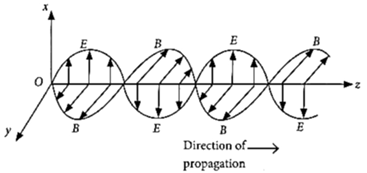
A stationary charge produces only an electrostatic field while a charge in uniform motion produces a magnetic field, that does not change with time. An oscillating charge is an example of accelerating charge. It produces an oscillating magnetic field, which in turn produces an oscillating electric fields and so on. The oscillating electric and magnetic fields regenerate each other as a wave which propagates through space.
Image
$(i).$ Magnetic field in a plane electromagnetic wave is given by $\vec{B}= B _0 \sin ( kx +\omega t ) \hat{j} T$Expression for corresponding electric field will be (Where c is speed of light.)
$(a) \vec{E}= B _0 c \sin ( kx +\omega t ) \hat{k} V / m$
$(b) \vec{E}=- B _0 c \sin ( kx -\omega t ) \hat{k} V / m$
$(c) \vec{E}=- B _0 c \sin ( kx +\omega t ) \hat{k} V / m$
$(d) \vec{E}=\frac{B_0}{c} \sin ( kx +\omega t ) \hat{k} V / m$
$(ii)$ The electric field component of a monochromatic radiation is given by $\vec{E}=2 E _0 \hat{i} \cos kz \cos \omega t$. Its magnetic field $\vec{B}$ is then given by
$(a) -\frac{2 E_0}{c} \hat{j} \sin kz \sin \omega t$
$(b) \frac{2 E_0}{c} \hat{j} \sin kz \sin \omega t$
$(c) \frac{2 E_0}{c} \hat{j} \sin kz \cos \omega t$
$(d) \frac{2 E_0}{c} \hat{j} \cos kz \cos \omega t$
$(iii)$ A plane em wave of frequency $25 \ MHz$ travels in a free space along $x -$direction. At a particular point in space and time, $E =(6.3 \hat{j}) V / m$. What is magnetic field at that time?
$(a) \ 0.089 \mu T$
$(b) \ 0.124 \mu T$
$(c) \ 0.021 \mu T$
$(d) \ 0.095 \mu T$
OR
A plane electromagnetic wave travels in free space along $x-$axis. At a particular point in space, the electric field along $y$-axis is $9.3 V m ^{-1}$. The magnetic induction $(B)$ along $z -$axis is
$(a) \ 3.1 \times 10^{-8} T$
$(b) \ 3 \times 10^{-5} T$
$(c) \ 3 \times 10^{-6} T$
$(d) \ 9.3 \times 10^{-6} T$
$(iv)$ A plane electromagnetic wave travelling along the $x-$direction has a wavelength of $3 \ mm$ . The variation in the electric field occurs in the $y-$direction with an amptitude $66 V m ^{-1}$. The equations for the electric and magnetic fields as a function of $x$ and $t$ are respectively
$ \text { a) } E_y =11 \cos 2 \pi \times 10^{11}\left(t-\frac{x}{c}\right), \text { b) } E_y =66 \cos 2 \pi \times 10^{11}\left(t-\frac{x}{c}\right),$
$B_y =11 \times 10^{-7} \cos 2 \pi \times 10^{11}\left(t-\frac{x}{c}\right) B_z =2.2 \times 10^{-7} \cos 2 \pi \times 10^{11}\left(t-\frac{x}{c}\right)$
$\text { c) } E_x =33 \cos \pi \times 10^{11}\left(t-\frac{x}{c}\right), \text { d) } E_y =33 \cos \pi \times 10^{11}\left(t-\frac{x}{c}\right),$
$B_x =11 \times 10^{-7} \cos \pi \times 10^{11}\left(t-\frac{x}{c}\right) B_z =1.1 \times 10^{-7} \cos \pi \times 10^{11}\left(t-\frac{x}{c}\right)$