Question
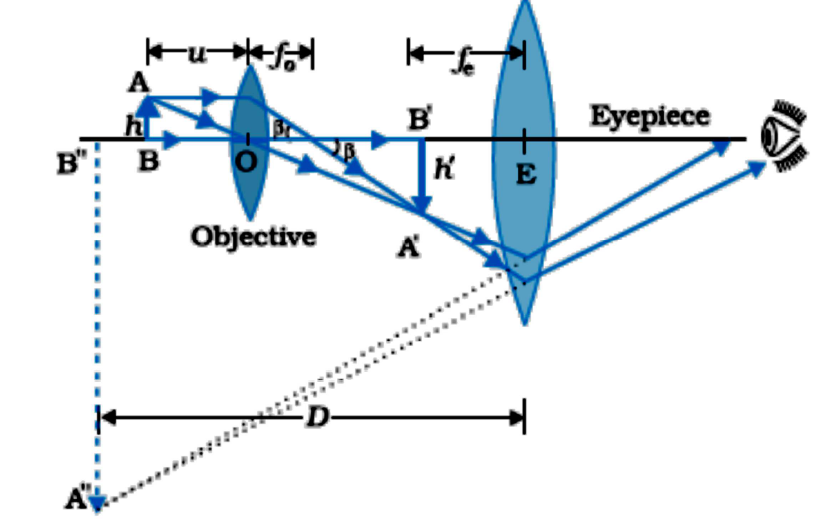
  1. Draw a labelled ray diagram showing the formation of a final image by a compound microscope at least distance of distinct vision.
  2. The total magnification produced by a compound microscope is 20. The magnification produced by the eye piece is 5. The microscope is focussed on a-certain object. The distance between the objective and eyepiece is observed to be 14 cm. If least distance of distinct vision is 20 cm, calculate the focal length of the objective and the eye piece.
Answer


For eyepiece $\text{m}_{e} = \frac{\text{v}_{e}}{\text{u}_{e}}$
$\text{u}_{e} = \frac{\text{v}_{e}}{\text{m}_{e}} = \frac{-20}{5}\text{cm} = - 4 \text{cm}$
Also, $\frac{1}{\text{f}_{e}}= \frac{1}{\text{v}_{e}} - \frac{1}{\text{u}_{e}}$
$\frac{1}{\text{f}_{e}} = \frac{-1}{20} + \frac{1}{4}$
$\text{f}_{e} = 5 \text{cm}$
$\text{m} = \text{m}_{e}\times \text{m}_{o}$
$-20 = 5 \times \text{m}_{o} = > \text{m}_{0} = -4$
Also, $|\text{v}_{o}| + |\text{u}_{e}| = 14$
$= > \text{v}_{o}= (14 – 4) \text{ cm} = 10\text{ cm}$
$\text{m}_{0} = 1-\frac{\text{v}_{o}}{\text{f}_{0}} = > -4= 1-\frac{10}{\text{f}_{o}}$
$= > \text{f}_{o} = 2\text{ cm}$
where subscripts e and o are used for eyepiece and objective respectively.

Need a full question paper?

Generate a complete, print-ready paper with questions like this in minutes — across 16+ boards, with answer keys.

Start Generating Free

Similar questions

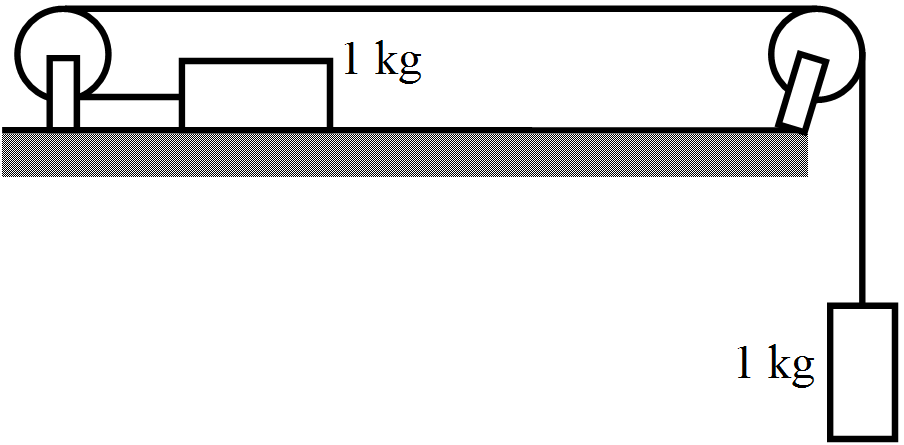
Calculate the tension in the string shown in figure. The pulley and the string are light and all surfaces are frictionless. Take $g = 10m/s^2.$
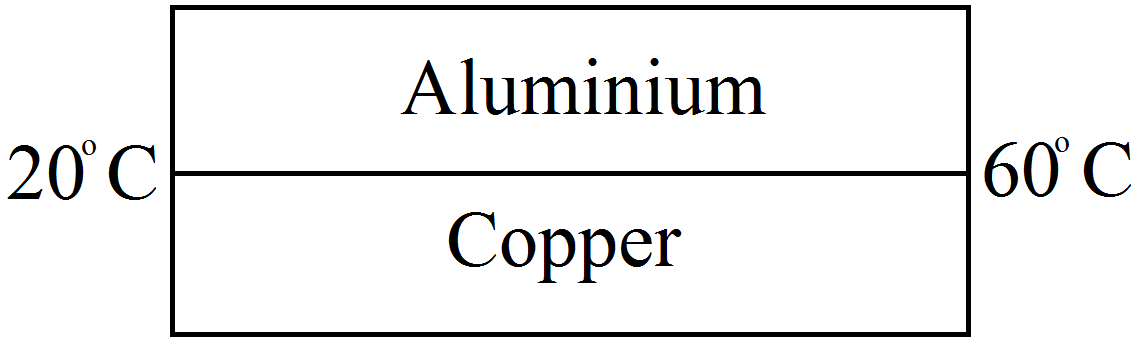
An aluminium rod and a copper rod of equal length 1.0m and cross-sectional area $1cm^2$ are welded together as shown in figure. One end is kept at a temperature of $20^\circ C$ and the other at $60^\circ C$. Calculate the amount of heat taken out per second from the hot end. Thermal conductivity of aluminium ${= 200Wm^{-1}}{^\circ C^{-1}}$ and of copper ${= 390Wm^{-1}}{^\circ C^{-1}.}$
  1. Six lead-acid type of secondary cells each of emf 2.0 V and internal resistance $0.015\Omega$ are joined in series to provide a supply to a resistance of $8.5\ \Omega.$ What are the current drawn from the supply and its terminal voltage?
  2. A secondary cell after long use has an emf of 1.9 V and a large internal resistance of $380\ \Omega$ What maximum current can be drawn from the cell? Could the cell drive the starting motor of a car?
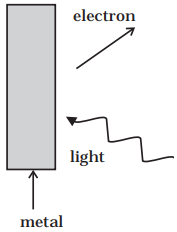
Consider Fig. for photoemission.
How would you reconcile with momentum-conservation? Note light (photons) have momentum in a different direction than the emitted electrons.
A charged particle having a charge of $-2.0 \times 10^{-6}C$ is placed close to a nonconducting plate having a surface charge density $4.0 \times 10^{-5}Cm^{-2}$. Find the force of attraction between the particle and the plate.
Why are alloys used for making standard resistance coils?
Suppose Swarglok (heaven) is in constant motion at a speed of 0.9999c with respect to the earth. According to the earth's frame, how much time passes on the earth before one day passes on Swarglok?
A bulb rated 60W at 220V is connected across a household supply of alternating voltage of 220V. Calculate the maximum instantaneous current through the filament.
Find the radius and energy of a $He^+$ ion in the states (a) n = 1, (b) n = 4 and (c) n = 10.
Find the energy liberated in the reaction:
$^{223}Ra → ^{209}Pb + ^{14}C.$
The atomic masses needed are as follows.
$^{223}Ra$ $^{209}Pb$ $^{14}C$
$22.018u$ $208.981u$ $14.003u$