Question
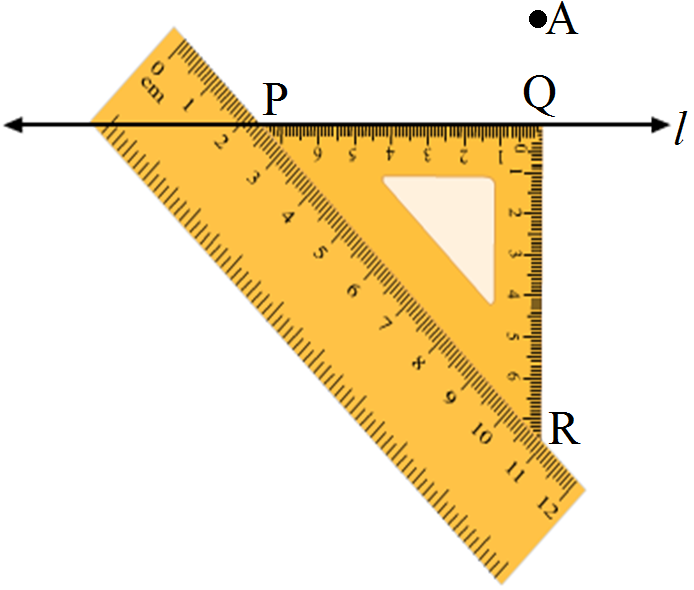
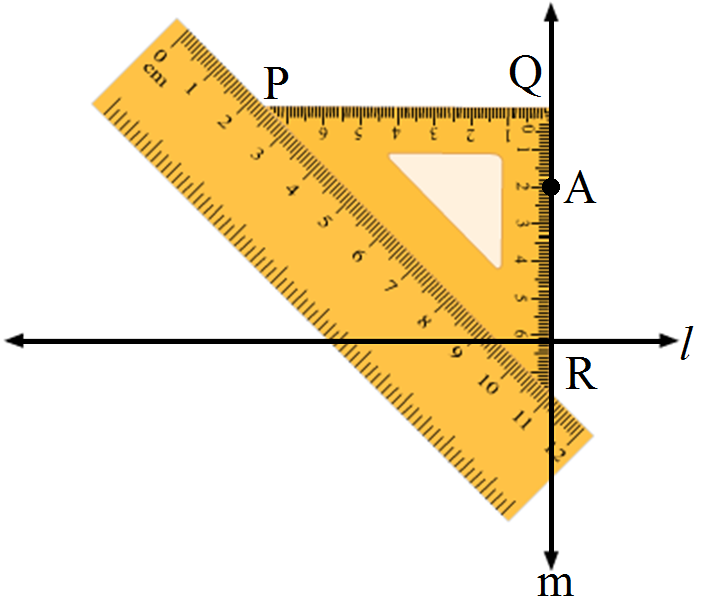
Draw a line l. Take a point A, not lying on l. Draw a line m such that $\text{m}\perp\text{l}$ and passing through A. Using ruler and a set-square.
Answer

We draw a line L and take a point A outside it.
Place a set square PQR such that its one arm PQ of the right angle is along the line L.
Without disturbing the position of set-square, place a ruler along its edge PR.
Now, without disturbing the position of the ruler, slide the set-square along the ruler until its arm QR reaches point A.
Without disturbing the position of the set-square, draw a line m.
Line m is the required line perpendicular to line L.

Need a full question paper?

Generate a complete, print-ready paper with questions like this in minutes — across 16+ boards, with answer keys.
Start Generating Free

Similar questions

Following figures relate the weekly wages (in Rs.) of 15 workers in a factory:
300, 250, 200, 250, 200, 150, 350, 200, 250, 200, 150, 300, 150, 200, 250
Prepare a frequency table
  1. What is the range in wages (in Rs.)?
  2. How many Workers are getting Rs. 350?
  3. How many of workers are getting the minimum wages?
The number of students of Std 6th and Std 7th who went to visit the Tadoba Tiger Project at Chandrapur was 140 and 196 respectively. The students of each class are to be divided into groups of the same number of students. Each group can have a paid guide. What is the maximum number of students that can be there in each group? Why do you think each group should have the maximum possible number of students?
Read the bar graph shown in Fig and answer the following questions:
  1. What is the information given by the bar graph?
  2. How many tickets of Assam State Lottery were sold by the agent?
  3. Of which state, were the maximum number of tickets sold?
  4. State whether true or false.
The maximum number of tickets sold is threetimes the mlnimum number of tickets sold.
  1. Of which state were the minimum number of tickets sold?
i. $3 \frac{1}{3}-1 \frac{1}{4}$
ii. $5 \frac{1}{2}-3 \frac{1}{3}$
iii. $7 \frac{1}{8}-6 \frac{1}{10}$
iv. $7 \frac{1}{2}-3 \frac{1}{5}$
Two ropes, one 8 metres long and the other 12 metres long are to be cut into pieces of the same length. What will the maximum possible length of each piece be?
The following are the details or the number of students in a class of 30 students in a class of 30 students present during a week.
Day
Number of students present
Monday
24
Tuesday
20
Wednesday
28
Thursday
30
Friday
26
Saturday
22
Represent the above data by a pictograph.
Give the correct matching of the statements of Column A and Column B.
No.
Column A
 
Column B
i
Points are collinear.
a.
May be parallel or intersecting.
ii
Line is completely known.
b.
Are undefined terms in geometry.
iii
Two lines in a plane.
c.
If they lie on the same line.
iv
Relations between points and lines.
d.
Can pall through a point.
v
Three non-collinear points.
e.
Determine a plane.
vi
A plane extends.
f.
Are called incidence porperties.
vii
Indefinite number of lines.
g.
It two points are givne.
viii
Point, line and plane are.
h.
Indefinitely in all directions.
Draw a line segment CD. Produce it to CE such that CE = 3CD.
Convert into improper fractions:
i. $7 \frac{2}{5}$
ii. $5 \frac{1}{6}$
iii. $4 \frac{3}{4}$
iv. $2 \frac{5}{9}$
v. $1 \frac{5}{7}$
$7 \frac{1}{2}-3 \frac{1}{5}$