Question
Draw a line segment $CD.$ Produce it to $CE$ such that $CE = 3CD.$
Answer

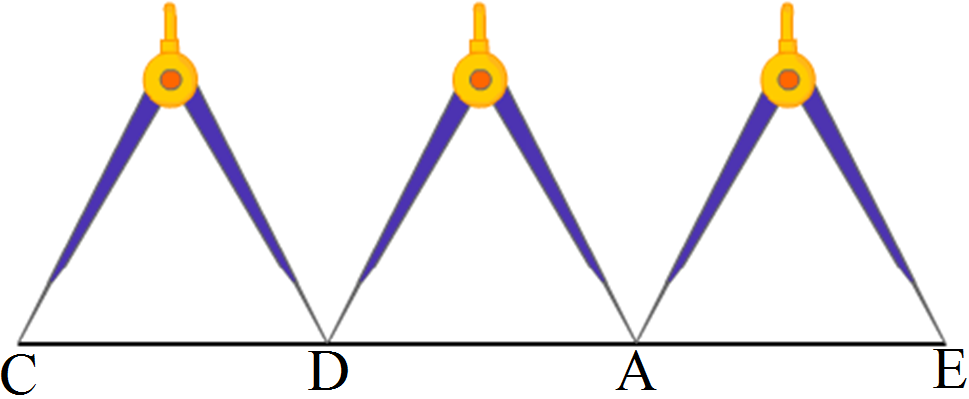
We draw a line l and take two points $C$ and $D$ on it.
Take a divider and open it such that its end of both arms is at $C$ and $D.$
Then, we lift the divider and place its one end at $D$ and other end on the line $l$ opposite to $C$ as shown in the figure.
Let this point be $A.$
Lift the divider again and place its one end at $A$ and other end on the line $1$ opposite to $C.$
Name this point as $E.$
Here $CD = DE = AE$
Therefore, $CE = CD + DE + AE$
$= CD + CD + CD ($As, $CD ± DE = AE)$
or, $CE = 3CD$

Need a full question paper?

Generate a complete, print-ready paper with questions like this in minutes — across 16+ boards, with answer keys.

Start Generating Free

Similar questions

In a Mathematics test, the marks were obtained by $40$ students. Arrange these marks in a table using tally marks.
$8$ $1$ $3$ $7$ $6$ $5$ $5$ $4$ $4$ $2$
$4$ $9$ $5$ $3$ $7$ $1$ $6$ $5$ $2$ $7$
$7$ $3$ $8$ $4$ $2$ $8$ $9$ $5$ $8$ $6$
$7$ $4$ $5$ $6$ $9$ $6$ $4$ $4$ $6$ $6$
How many students obtained marks below $4?$
Draw a circle with centre at point $O.$ Draw its two chords $AB$ and $CD$ such that $AB$ is not parallel to $CD.$ Draw the perpendicular bisectors of $AB$ and $CD.$ At what point do they intersect$?$
Use number line and add the integers: $(-1) + (-2) + (-3)$
There are $20$ girls and $15$ boys in a class. What is the ratio of number of girls to the total number of students in the class?
Write the first four products of two numbers with difference 4 starting from in the following order: 
1, 2, 3, 4, 5, 6, ........
Identify the pattern in the products and write the next three products.
In a Mathematics test, the marks were obtained by $40$ students. Arrange these marks in a table using tally marks.
$8$ $1$ $3$ $7$ $6$ $5$ $5$ $4$ $4$ $2$
$4$ $9$ $5$ $3$ $7$ $1$ $6$ $5$ $2$ $7$
$7$ $3$ $8$ $4$ $2$ $8$ $9$ $5$ $8$ $6$
$7$ $4$ $5$ $6$ $9$ $6$ $4$ $4$ $6$ $6$
Find how many students obtained marks equal to or more than $7.$
Complete the following table:
No. Shapes Rough figure Number of lines of symmetry
$(i)$ Scalene triangle $0$
$(ii)$ Isosceles triangle $1$
$(iii)$ Equilateral triangle    
$(iv)$ Rectangle    
$(v)$ Square    
$(vi)$ Parallelogram    
$(vii)$ Rhombus    
$(viii)$ Line    
$(ix)$ Line segment    
$(x)$ Angle    
$(xi)$ Isosceles trapezium    
$(xii)$ Kite    
$(xiii)$ Arrow head    
$(xiv)$ Semi-circle    
$(xv)$ Circle    
$(xvi)$ Regular pentagon    
$(xvii)$ Regular pentagon    
Draw wherever possible, a rough sketch of
(a) a triangle with atleast two lines of symmetry and atleast two angles of symmetry.
(b) a triangle with only one line of symmetry but not having rotational symmetry.
(c) a quadrilateral with rotational symmetry but no reflection symmetry.
(d) a quadrilateral with reflection symmetry but not having rotational symmetry.
Given $\overline {AB}$ of length $7.3 \ cm$ and $\overline {CD}$ of length $3.4\ cm,$ construct a line segment $\overline {XY}$ such that the length of $\overline {XY}$ is equal to the difference between the lengths of $\overline {AB}$ and $\overline {CD}$. Verify by measurement.
The angles of a triangle are in the ratio $1 : 2 : 3.$ The measure of the largest angle is: